
Indian Craft Traditions That Belong in Contemporary Interiors
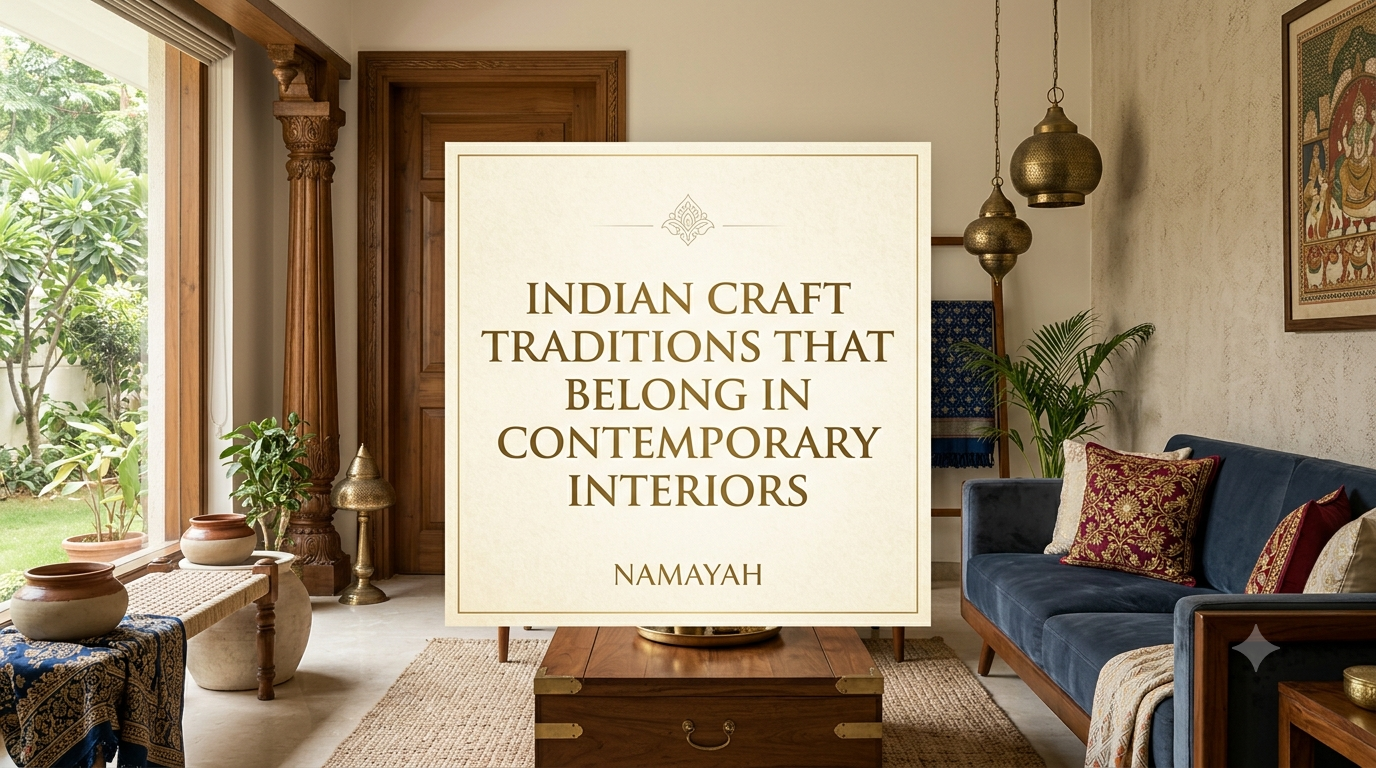
Indian craft traditions bring something that many contemporary interiors lack: texture, material character, regional identity, and a visible connection to the maker. The key is not to fill a modern home with traditional objects. Instead, carefully chosen pieces can become focal points that complement clean architecture, neutral palettes, modern furniture, and uncluttered spaces.
India has an exceptionally diverse craft heritage, including textiles, embroidery, painting, metalwork, woodwork, terracotta, grass craft, and printing traditions. The Development Commissioner (Handicrafts), Ministry of Textiles, describes Indian crafts as deeply connected to regional identity while also noting that they continue to evolve alongside modern aesthetics.
For contemporary interiors, the most successful approach is usually one strong craft statement supported by restrained surroundings.
Why Indian Crafts Work in Modern Homes
Contemporary interiors often rely on simple forms and controlled palettes. That simplicity creates an ideal backdrop for handcrafted objects.
A hand-painted panel can provide visual movement against a plain wall. A woven textile can soften a room dominated by hard surfaces. A sculptural metal object can introduce irregularity into an otherwise geometric setting.
Indian crafts are particularly versatile because they encompass many visual languages. Some are intricate and decorative; others are minimal, tactile, earthy, or geometric.
The result does not have to look traditionally Indian. A contemporary room can use Indian craftsmanship in the same way it might use Japanese ceramics, Scandinavian textiles, or African sculpture: as a considered layer of material and cultural character.
Madhubani Painting for Expressive Contemporary Walls
Madhubani, or Mithila painting, is one of India’s best-known painting traditions and is associated with Bihar. Madhubani Paintings are also listed as a registered Geographical Indication in India’s official GI records.
Known for distinctive line work, patterns, figures, and narrative compositions, Madhubani can make a powerful contemporary art statement.
Instead of covering an entire room with traditional motifs, consider:
- A large framed Madhubani artwork above a console
- A monochrome interpretation in a minimalist living room
- A small series of related works arranged as a gallery wall
- A single piece placed against a quiet, neutral wall
The contrast between detailed artwork and simple architecture is what makes the combination work.
Best rooms for Madhubani
Living rooms, entryways, studies, and dining areas can all accommodate Madhubani art. In smaller spaces, a single well-framed work may have more impact than several decorative pieces.
Kalamkari for Pattern and Storytelling
Kalamkari offers another way to introduce Indian craftsmanship through both art and textiles. Traditional Kalamkari is associated with painted and printed textile traditions, including registered GI examples such as Machilipatnam Kalamkari and Srikalahasthi Kalamkari in India’s GI records.
Its detailed botanical, figurative, and narrative vocabulary makes it particularly useful when a room needs pattern without relying on mass-produced décor.
Try Kalamkari as:
- Upholstery on an occasional chair
- A framed textile panel
- Cushion covers
- Drapery used selectively
- A decorative runner
- Artwork in a reading corner
For a contemporary result, pair patterned Kalamkari with plain upholstery, simple silhouettes, and fewer competing accessories.
Dhokra Metal Craft as Sculptural Décor
If textiles and paintings feel too decorative for your space, metal craft can provide a more architectural alternative.
Dhokra is particularly interesting for contemporary interiors because handcrafted metal objects can function almost like small sculptures. Registered GI traditions include Bastar Dhokra and Bengal Dokra, among others.
A Dhokra object can work on:
- A console table
- Open shelving
- A bookshelf
- A sideboard
- A pedestal
- A coffee table arrangement
The most contemporary approach is to give the object room to breathe. Rather than surrounding it with numerous decorative pieces, treat it as a sculptural focal point.
Indian Handloom Textiles for Softer Interiors
Textiles are among the easiest ways to introduce Indian craft traditions into a modern home.
Handwoven fabrics can add visual and physical warmth to spaces dominated by glass, stone, metal, or polished wood. Depending on the weaving tradition and material, they can be used for cushions, throws, curtains, upholstery, bedcovers, and rugs.
The advantage of textiles is flexibility. You can change them seasonally or move them between rooms without redesigning the entire interior.
For a restrained look, choose one dominant textile pattern and combine it with solid-colored fabrics.
A handwoven throw on a contemporary sofa, for example, can introduce craftsmanship without changing the room’s overall character.
Ikat for Contemporary Geometric Interiors
Ikat is particularly well suited to modern spaces because its visual language can complement geometric furniture and architectural lines.
Ikat textiles can be used for:
- Accent cushions
- Upholstered stools
- Bed runners
- Curtains
- Accent chairs
- Decorative wall panels
The key is scale. If the Ikat pattern is strong, let the surrounding furniture remain visually quiet.
A modern dining room with a plain table, streamlined chairs, and a carefully chosen Ikat textile can feel contemporary while still carrying a strong Indian design identity.
Block Printing for Everyday Character
Indian block printing offers an approachable way to bring craft into interiors.
Unlike a single large artwork, printed textiles can be distributed throughout a room. They can appear in cushions, table linens, curtains, quilts, and lightweight upholstery.
The craft works particularly well in homes that already combine modern furniture with natural materials.
For example, a neutral sofa, timber coffee table, woven basket, and block-printed cushions can create a relaxed interior without requiring heavily decorative furniture.
The important principle is repetition without excess: repeat a pattern or color in two or three places rather than covering every surface.
Pattachitra as Contemporary Wall Art
Pattachitra is another traditional Indian painting tradition that can be considered for modern interiors. Its highly detailed visual character makes it naturally suited to spaces where art is intended to be the main focal point.
Instead of treating Pattachitra as general decoration, frame it thoughtfully and position it where the artwork can be viewed clearly.
A large artwork above a low contemporary cabinet can create a strong horizontal composition. In a hallway or entry, a smaller framed piece can provide an immediate visual point of interest.
The surrounding wall should remain relatively quiet so the details of the artwork do not compete with other elements.
Sikki Grass Craft for Natural Texture
Contemporary interiors increasingly benefit from natural materials because they soften the visual hardness of modern architecture.
Sikki grass craft from Bihar offers an example of how natural-fibre craftsmanship can be incorporated into interiors. Sikki Grass Products of Bihar are included among India’s registered GI handicraft products.
Depending on the form, natural-fibre craft can be used for:
- Baskets
- Decorative containers
- Wall pieces
- Storage
- Tabletop accents
These objects work especially well alongside wood, linen, stone, clay, and other tactile materials.
Rather than treating them as purely decorative accessories, use them for practical storage where possible. Functional craftsmanship often feels more natural in contemporary interiors.
Sujini Embroidery for Storytelling Through Textiles
Sujini embroidery demonstrates how a traditional craft can adapt to contemporary expression. The Government of India’s handicrafts compendium describes Sujini products including bedspreads, wall hangings, cushion and bolster covers, and clothing, while noting that contemporary social and political themes have also entered its imagery.
That makes embroidered textiles especially interesting for modern homes.
A Sujini textile can be displayed as:
- Framed wall art
- A bedroom accent
- A cushion
- A wall hanging
- A layered textile installation
Its handcrafted irregularity can provide contrast against clean contemporary furniture.
Bastar Dhokra and Wooden Craft for Earthy Spaces
For interiors built around timber, stone, clay, and neutral colors, crafts from Bastar can provide a natural complement.
Official GI records recognize Bastar Dhokra and Bastar Wooden Craft among India’s registered handicraft traditions.
These materials can be particularly effective in interiors inspired by biophilic or earthy design.
Think of a restrained arrangement:
Natural wood + limewashed wall + woven textile + handcrafted metal object + greenery.
The result feels contemporary because the composition is simple, even though the individual materials carry deep craft traditions.
How to Mix Indian Crafts With Contemporary Design
The biggest mistake is assuming that every traditional object needs to be displayed together.
A better approach is to create contrast and hierarchy.
1. Start with a neutral foundation
White, cream, warm grey, beige, natural timber, and muted stone can provide a calm background for detailed craft pieces.
2. Choose one hero piece
A large painting, sculptural metal object, statement textile, or handcrafted furniture piece can anchor the room.
3. Limit competing patterns
If the artwork is intricate, keep upholstery and larger furniture relatively simple.
4. Mix materials
Combine textile with wood, metal with stone, or grass craft with ceramic. Material contrast keeps a space visually interesting without requiring excessive color.
5. Let handmade irregularity remain visible
Handmade objects do not need to look perfectly uniform. Slight variations can be part of their character.
6. Avoid creating a theme room
A contemporary interior does not need every element to reference Indian tradition. One or two thoughtfully selected craft traditions can be more effective than an entire collection displayed at once.