
Why Small Imperfections Make Handmade Products Special
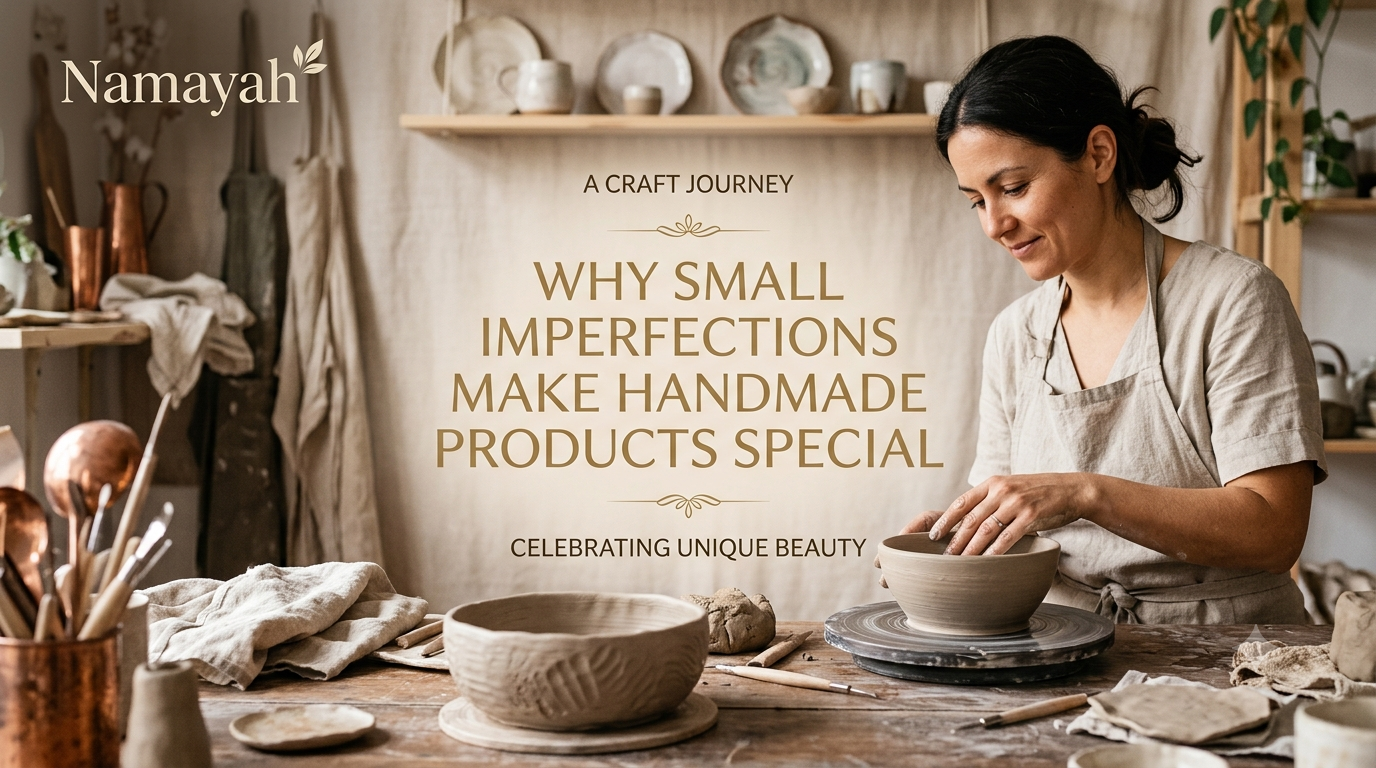
A perfectly uniform product may look impressive, but handmade products often have something machines cannot easily reproduce: individual character. A slightly uneven stitch, a subtle variation in glaze, a tiny difference in color, or a natural change in texture can show that a real person shaped the item.
These small imperfections are not automatically signs of poor quality. In many handmade products, they are natural results of the materials, tools, techniques, and human decisions involved in making each piece. Research into consumer behavior has found that handmade products can be valued for qualities such as authenticity, uniqueness, effort, and the emotional meaning people associate with human craftsmanship.
That does not mean every defect should be accepted. A handmade product should still be functional, thoughtfully made, and accurately represented. The distinction is important: a charming variation can add character, while a serious manufacturing problem can reduce quality.
What Counts as an Imperfection in Handmade Products?
Handmade imperfections are usually small variations that naturally occur during the crafting process.
Depending on the material and technique, they may include:
- Slight differences in shape
- Minor variations in color
- Uneven but intentional-looking stitching
- Small changes in texture
- Subtle differences in glaze
- Slight variations in printed patterns
- Natural marks in wood or leather
- Tiny differences between individual pieces
For example, two handmade ceramic mugs created by the same artisan may have nearly identical designs but slightly different glaze patterns. Two handwoven textiles may use the same colors and pattern while showing small differences in weave tension.
These details are part of what separates handmade production from highly standardized manufacturing.
Handmade Does Not Mean Poor Quality
It is important not to confuse handmade character with careless workmanship.
A well-made handmade product can contain natural variations while still meeting high standards for construction, safety, durability, and function. Craftsmanship is about much more than visual perfection. It can involve material selection, technique, patience, precision, finishing, and the maker’s accumulated skill.
Shopify’s overview of craftsmanship highlights durability, tradition, uniqueness, and customer satisfaction as important values associated with quality craftsmanship. It also notes that some makers deliberately highlight small imperfections as distinguishing features.
A useful way to think about it is:
| Natural Handmade Variation | Potential Defect |
|---|---|
| Slight color variation | Unexpected discoloration from damage |
| Minor shape variation | Structure that does not function correctly |
| Small differences between pieces | Poorly assembled components |
| Natural material marks | Cracks that compromise durability |
| Subtle irregular stitching | Loose or failing seams |
The goal is not perfection at any cost. The goal is intentional, functional, skilled craftsmanship.
Imperfections Make Every Piece Unique
One of the biggest attractions of handmade products is individuality.
A factory production line is designed to make thousands or millions of items as consistently as possible. That consistency is valuable when consumers want predictable dimensions, colors, and performance.
Handmade production works differently. Even when an artisan follows the same process repeatedly, materials and human movements can introduce small differences.
This means your handmade bowl may not look exactly like another bowl from the same collection. Your handwoven scarf may have a slightly different pattern balance. Your wooden object may contain a grain pattern that exists nowhere else.
That uniqueness can be part of the product’s value.
Research on handmade consumption has connected handmade production with perceptions of authenticity and consumers’ desire for uniqueness.
Instead of owning one identical item among thousands, a customer can feel that they own their particular version of a design.
Small Variations Reveal the Human Hand
A handmade object can carry physical evidence of how it was made.
Consider a hand-thrown ceramic piece. The artisan must respond to the clay as it moves through their hands. A hand-printed textile requires decisions about pressure, placement, material, and repetition. A hand-carved wooden object depends on the grain of the wood as well as the maker’s tools and technique.
These processes can leave subtle variations behind.
That is precisely why an irregularity can be interesting. It gives the customer a clue about the process that created the object.
The imperfection becomes a kind of visual signature.
Instead of asking, “Why isn’t this exactly like the factory version?” a buyer may ask, “What can this detail tell me about how it was made?”
Authenticity Is Part of the Appeal
People do not always buy handmade products simply because of their physical function.
They may also care about the story behind the object, the materials used, the skill involved, or the fact that a person—not an entirely automated process—made it.
Academic research has identified a positive “handmade effect,” finding that handmade products can become more attractive partly because consumers associate them with human effort and emotional meaning.
This helps explain why a small irregularity can sometimes increase perceived authenticity.
A perfectly identical surface can communicate industrial consistency. A subtle variation can communicate human involvement.
Neither is inherently better. They simply communicate different values.
The Craftsmanship Behind the Imperfection
An imperfection may take only a second to notice, but creating the product around it can require years of learned skill.
An experienced artisan understands how materials behave and how to respond when something changes during production. They may know how much pressure to apply, how to recognize a useful natural variation, or when a flaw is serious enough to require correction.
That distinction matters.
The beauty of handmade work does not come from deliberately making things badly. It comes from mastering a process in which complete uniformity is neither possible nor always desirable.
Craftsmanship therefore combines control with adaptation.
The maker aims for a high-quality result while working with the realities of natural materials and human hands.
Handmade vs. Mass-Produced Products
Handmade and mass-produced products can both be excellent choices. Their strengths are simply different.
| Feature | Handmade Products | Mass-Produced Products |
| Consistency | Often contains small variations | Usually highly standardized |
| Individuality | Each piece can feel distinctive | Identical versions are common |
| Production | Human-led or substantially hand-crafted | Industrial and automated processes are common |
| Character | Often visible in materials and workmanship | Usually designed for uniformity |
| Customization | Often easier for individual makers | Usually limited by production systems |
| Craft story | May be central to the product | Usually less visible to the customer |
The choice depends on what the buyer values.
Someone furnishing a commercial space may prioritize exact consistency. Someone buying a gift may value individuality and the story behind a handmade object.
Research also shows that the handmade effect is not universal. Consumer responses can depend on context and individual circumstances, meaning handmade is not automatically preferred by everyone.
That nuance makes the appreciation of handmade products more credible: their appeal is real, but it is not the same for every person or every purchase.
Why People Connect Emotionally With Handmade Goods
A handmade product can feel personal because the process behind it is easier to imagine.
You can picture someone cutting the material, shaping the form, choosing the colors, sewing the pieces, carving the surface, or applying the final finish.
That imagined connection can change how people perceive an object.
The research behind the “handmade effect” found that perceptions of love and care can contribute to the appeal of handmade products, particularly in contexts such as gift giving.
This is one reason handmade gifts can feel especially meaningful.
The recipient is not only receiving an object. They may also be receiving a reminder of human effort, creativity, and intention.
Imperfection Can Tell a Story
A handmade item can preserve traces of its making.
A small variation in a textile may reflect the printing or weaving process. A wood grain pattern can reveal the natural material used. A ceramic glaze variation may show how the surface responded during firing.
These details help distinguish an object from an anonymous commodity.
For buyers interested in traditional crafts, the story can be even more significant. Handmade production may preserve techniques and cultural practices that have been passed from one generation to another.
In that sense, an object’s individuality can connect the present to a much longer history of making.
Examples of Beautiful Handmade Imperfections
Different crafts reveal imperfection in different ways.
Handmade Ceramics
Small variations in glaze, shape, or surface texture can make each ceramic piece distinctive.
Handwoven Textiles
Changes in thread tension, weave, or pattern placement can occur naturally during weaving.
Woodcraft
Natural knots, grain patterns, color differences, and subtle tool marks can contribute to character.
Handmade Leather Goods
Natural variation in grain and tone can mean that two leather products never look completely identical.
Hand-Printed Products
Slight differences in ink coverage or pattern placement can reveal that a design was printed by hand.
Handmade Jewelry
Tiny variations in shaping, texture, or finishing can distinguish one artisan-made piece from another.
The important point is that these variations should be appropriate to the craft and should not compromise the product’s intended use.
When an Imperfection Is Actually a Defect
Appreciating imperfection does not mean ignoring quality.
Customers should be able to distinguish between expected variation and a genuine problem.
A minor difference in color may be normal for a hand-dyed product. A structural crack that makes an item unsafe is not simply “character.”
Likewise, an artisan-made bag can have natural variations in leather grain while still requiring secure stitching and functional hardware.
When buying handmade products, consider:
- Does the variation come from the material or process?
- Does it affect functionality?
- Was the variation clearly explained by the maker?
- Does the product meet reasonable quality expectations?
- Is the item consistent with its description and photographs?
Responsible makers can help by explaining which variations customers should expect.
How to Appreciate Handmade Products
The best way to appreciate handmade goods is to look beyond perfect symmetry.
Notice the materials. Look at the texture. Consider the construction. Think about the process required to create the object.
Ask questions such as:
- Who made this?
- What materials were used?
- Which parts were made by hand?
- What traditional or specialized techniques were involved?
- What variations should I expect?
- How should I care for the product?
This approach shifts attention from simply asking whether an object looks perfect to asking whether it has been made well and intentionally.
That is a much more useful standard for handmade products.
Why Handmade Products Feel More Personal
Mass-produced products are designed around repeatability. Handmade products can be designed around expression.
That difference can make an artisan-made object feel more connected to its owner.
A handmade product may also become more meaningful over time. Instead of looking exactly the same as every other item, it carries its own combination of material characteristics and maker-specific details.
The result is an object with personality.
This is particularly valuable in a world filled with standardized products. A handmade piece can introduce variation into an otherwise uniform environment.
How Makers Can Explain Imperfections to Customers
For artisans and handmade businesses, communication is essential.
Calling every irregularity a “beautiful imperfection” is not enough. Customers deserve clear information about what they are purchasing.
A product description can explain:
- Which variations are natural
- Why colors or textures may differ
- Whether dimensions can vary slightly
- Which marks are characteristic of the material
- How the product was made
- Which qualities should not be considered defects
Clear descriptions build realistic expectations.
They also help customers understand that handmade quality is not about reproducing an industrial object with less precision. It is about producing something with a different kind of value.
The Lasting Value of Handmade Character
Small imperfections make handmade products special because they can show individuality, human effort, material character, and authenticity.
They remind us that the object was created through a process rather than simply produced by a system.
But the most important distinction is this: handmade imperfection should be meaningful, not an excuse for poor quality.
A beautifully made handmade product can be carefully constructed while still showing subtle signs of its maker. Those signs are often what make the piece feel personal.
In a culture that frequently rewards uniformity, handmade products offer another idea of beauty—one where variation can be part of the design, and where the evidence of human hands is something worth preserving.
FAQs About Handmade Product Imperfections
Are imperfections normal in handmade products?
Yes. Small variations in color, texture, shape, stitching, or pattern can be normal because handmade products involve human processes and materials that naturally vary. However, serious structural or functional problems should still be treated as defects.
Why are handmade products unique?
Handmade products can be unique because artisans work with individual materials, tools, techniques, and decisions. Even when the same design is repeated, small differences can occur between pieces.
Do imperfections make handmade products more valuable?
They can contribute to perceived value by signaling individuality, authenticity, and human craftsmanship. However, value also depends on the quality of materials, skill, design, durability, and the buyer’s preferences.
Are handmade products better than mass-produced products?
Not necessarily. Handmade and mass-produced products serve different needs. Handmade goods may appeal to buyers who value individuality and craftsmanship, while mass-produced products often provide consistency, scalability, and predictable specifications.
What is the difference between handmade imperfections and defects?
A handmade imperfection is usually a minor, process-related variation that does not affect the product’s intended function. A defect is a problem that compromises quality, durability, safety, appearance beyond reasonable expectations, or functionality.
Why do people like imperfect handmade items?
People may associate handmade variations with authenticity, uniqueness, human effort, and emotional meaning. Research suggests these perceptions can influence how consumers evaluate handmade products.
Should handmade sellers disclose imperfections?
Yes. Clear communication helps customers understand what variations are normal and what quality standards they can expect. Transparent descriptions can reduce misunderstandings and create more realistic expectations.
What handmade products show imperfections most clearly?
Ceramics, textiles, woodwork, leather goods, jewelry, paintings, pottery, and hand-printed products can all show natural variations. The specific characteristics depend on the materials and production techniques.
Can handmade products still be high quality if they are imperfect?
Absolutely. High-quality craftsmanship does not always require visual uniformity. A product can be carefully designed, durable, functional, and skillfully made while retaining subtle evidence of the human process.
Why do handmade gifts feel special?
Handmade gifts can communicate individuality and human effort. Research has found that the perceived emotional meaning associated with handmade production can be particularly relevant when people purchase products as gifts.
Conclusion
The charm of handmade products often lies in details that would disappear in a perfectly standardized production process. A slight variation in color, texture, shape, or stitching can become a reminder that a real person made the object.
Those details do not automatically make a product better. Quality, functionality, durability, and honest communication still matter. But when a small variation is a natural result of skilled craftsmanship, it can give a product something that uniform production cannot easily reproduce: a sense of individuality and human character.
That is why small imperfections can make handmade products special. They are often not merely marks of what the product is—they are clues to how, why, and by whom it was made.