
Why Global Designers Are Rediscovering Indian Handicrafts
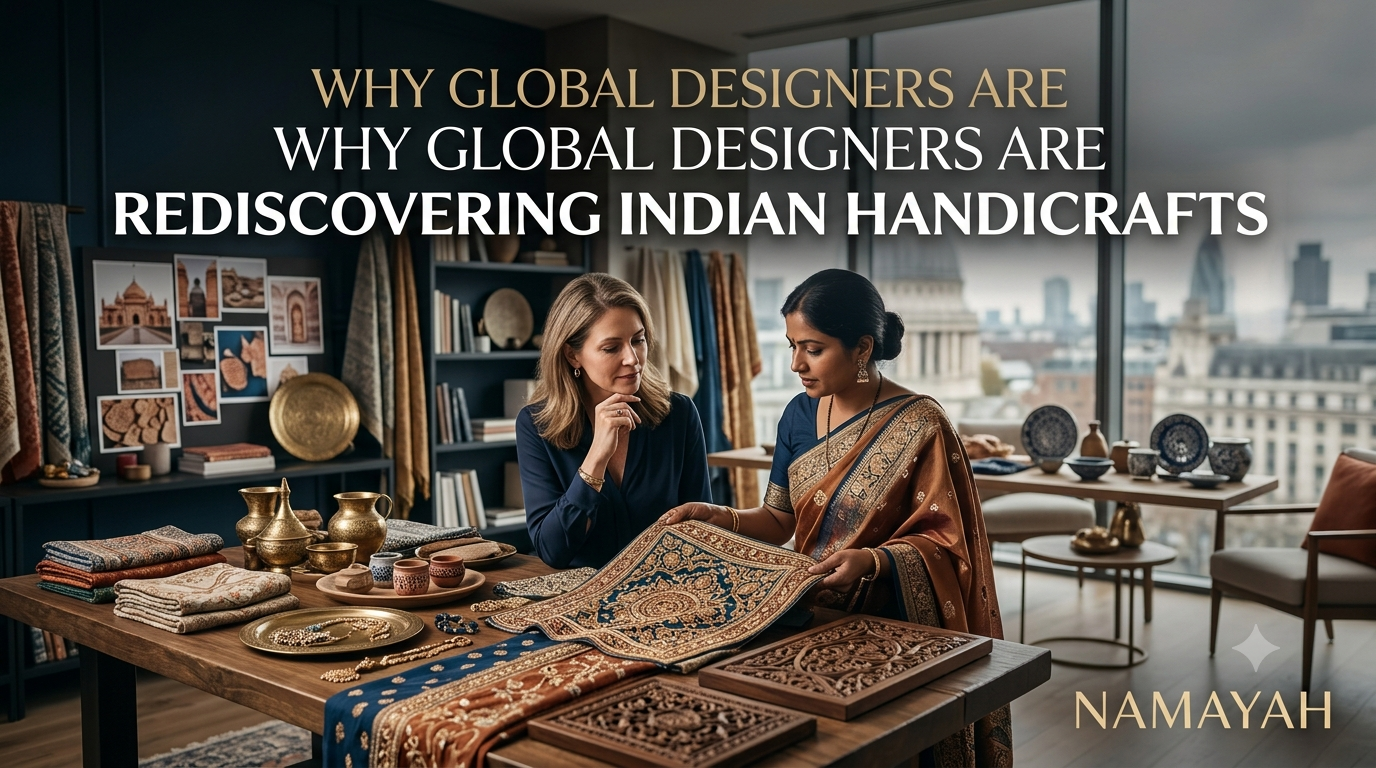
Indian handicrafts are experiencing renewed attention from designers who want more than visual appeal from the objects, textiles, and materials they use. They offer something increasingly valuable in contemporary design: craftsmanship, cultural identity, material variation, and a story that can be traced back to people and places.
The renewed interest is not simply a return to traditional décor. Instead, global designers are rediscovering Indian handicrafts by combining centuries-old techniques with contemporary forms, colors, materials, and applications.
This shift is visible across fashion, interiors, furniture, accessories, hospitality, and lifestyle design. It also reflects a broader appreciation for handmade products and regional craft traditions.
India’s handicraft export sector provides evidence of continuing international demand. Government data reports that handicraft exports excluding hand-knotted carpets reached ₹33,122.79 crore in 2024–25, compared with ₹20,082.53 crore in 2014–15. Major categories included woodwares, art metal wares, handprinted textiles, and embroidered and crocheted goods.
Indian Handicrafts Are More Than Decoration
A handmade object can carry information that a mass-produced object often cannot: where it came from, which technique produced it, what materials were used, and how much human skill was required.
Indian handicrafts are particularly diverse because different regions developed their own materials, motifs, weaving traditions, carving methods, dyeing processes, embroidery styles, and production techniques.
Consider the difference between a hand-block-printed textile and a digitally printed fabric. Both can produce attractive patterns, but the handmade process creates its own physical characteristics. Slight variations can become part of the object’s identity rather than imperfections to eliminate.
For designers, this creates an opportunity to introduce texture, individuality, and provenance into a project.
A New Appreciation for Handmade Design
For decades, industrial production helped make design more accessible and scalable. Yet the same efficiency also created visual repetition.
Today’s designers increasingly work in an environment saturated with standardized products. Handmade craft offers an alternative.
A handwoven textile, carved wooden panel, hammered metal object, or hand-finished ceramic piece can give a space a sense of individuality.
This does not mean contemporary designers are rejecting modern manufacturing. Instead, many projects combine industrially produced elements with carefully selected handmade pieces.
The contrast can be powerful:
- Clean architectural lines paired with handwoven textiles
- Modern furniture combined with carved wood
- Minimal interiors accented by Indian metalwork
- Contemporary clothing incorporating traditional embroidery
- Modern lighting inspired by regional craft techniques
The result is not necessarily “traditional.” It can be distinctly contemporary while retaining a connection to craft.
The Power of Craftsmanship and Detail
Indian handicrafts depend on accumulated knowledge.
Weaving, embroidery, carving, dyeing, printing, metalworking, pottery, and other crafts often require practical skills that develop through long periods of learning and repetition.
The Development Commissioner (Handicrafts), Ministry of Textiles, describes the sector as labor-intensive and highlights its potential for employment, value addition, and export earnings.
For designers, this expertise can become part of the design language itself.
A surface may look simple from a distance but reveal intricate workmanship up close. A textile may appear to have a straightforward pattern while requiring complex preparation and handwork.
That tension between simplicity and labor is one reason handmade Indian craft can work so well in modern design.
Traditional Techniques Meet Contemporary Design
The revival of Indian handicrafts does not depend on reproducing historical objects exactly as they were.
Contemporary designers can reinterpret traditional techniques for new applications.
A traditional weaving technique might become a modern wall installation. A historic embroidery vocabulary might appear on a minimalist garment. A regional carving style could influence contemporary furniture.
Recent coverage of Indian fashion has highlighted designers and craft initiatives that are bringing regional techniques into modern fashion contexts, including work associated with Kutch artisans and established Indian designers.
This approach matters because traditions survive when they remain useful and adaptable.
The goal is not to freeze craft in the past. It is to allow traditional knowledge to participate in the present.
Textiles Are Leading the Revival
Textiles remain one of the most visible areas where Indian craftsmanship intersects with global design.
India has an exceptionally broad textile heritage, including handloom weaving, block printing, embroidery, resist dyeing, ikat, silk weaving, and other regional techniques.
Examples include:
- Banarasi textiles from Varanasi, known for elaborate weaving traditions
- Pochampally Ikat from Telangana
- Kanchipuram silk from Tamil Nadu
- Chanderi textiles from Madhya Pradesh
- Patan Patola from Gujarat
- Regional block printing and embroidery traditions from Rajasthan, Gujarat, West Bengal, Punjab, and other craft centers
Several Indian textile traditions have also received Geographical Indication recognition, helping connect particular products with their regional origins.
For global designers, these textiles provide more than patterns. They offer distinctive material qualities and a sense of place.
Wood, Metal, Clay and Natural Materials
The Indian handicraft story extends well beyond textiles.
Woodworking, metal craft, pottery, stonework, basketry, natural-fiber products, and other material traditions are also finding relevance in contemporary interiors and product design.
These materials can introduce warmth and tactile contrast into spaces dominated by glass, steel, concrete, and synthetic finishes.
A hand-finished wooden object can soften a minimalist interior. Metal craft can provide visual weight. Earthenware can introduce an organic quality.
The appeal comes partly from the fact that these materials communicate their physical origins.
Instead of hiding the process, contemporary design can make the process visible.
Sustainability Is Changing the Design Conversation
Sustainability is another reason handmade craft can be attractive to modern designers, although handmade does not automatically mean sustainable.
Responsible evaluation still requires attention to materials, production methods, transportation, durability, working conditions, and sourcing.
However, craft production can offer characteristics that align with some responsible-design goals: localized knowledge, repairability, long product life, and production methods that do not depend entirely on highly automated manufacturing.
The strongest approach is therefore not to label every handicraft product “sustainable,” but to examine its complete supply chain.
For designers, that means asking:
- Who made the product?
- Where were the materials sourced?
- How was it produced?
- How durable is it?
- Can it be repaired or maintained?
- Is the artisan fairly compensated?
- Can the product’s provenance be documented?
These questions turn sustainability from a marketing phrase into a design practice.
The Story Behind the Object Matters
Modern consumers increasingly encounter products through images and short-form content. In such an environment, storytelling can help an object stand out.
A handcrafted product can tell multiple stories simultaneously.
There is the story of the material.
There is the story of the technique.
There is the story of the artisan or community.
And there is the story of the region where the craft developed.
This makes Indian handicrafts particularly suitable for hospitality projects, luxury interiors, fashion collections, cultural spaces, and residential design where atmosphere and narrative are important.
The object becomes more than an accessory. It becomes a conversation point.
Global Markets Are Already Paying Attention
The international market provides another reason to take the revival seriously.
India’s handicraft exports excluding hand-knotted carpets reached ₹33,122.79 crore in 2024–25, according to government information. Woodwares accounted for ₹8,524 crore, while art metal wares accounted for ₹4,386 crore and embroidered and crocheted goods for ₹4,350 crore.
The United States was identified as a major destination, while Indian handicraft products also reached other international markets.
More broadly, India’s textiles and apparel exports, including handicrafts, reached ₹3,25,339 crore in 2025–26, according to provisional government data. Exports recorded growth across more than 100 destinations during that period.
These figures should not be interpreted as proof that every global designer is embracing Indian craft. They do, however, demonstrate that Indian textile and handicraft products have a substantial international commercial presence.
Technology Is Helping Traditional Craft Reach New Audiences
Digital platforms have changed how craft is discovered.
A designer in London, New York, Dubai, Paris, or Sydney can now encounter Indian artisans and craft organizations without physically traveling to a traditional craft center.
The Indian handicrafts administration itself lists international exhibitions, buyer-seller meetings, overseas workshops, design exchanges, and international market research among activities used to develop export opportunities.
Technology can therefore act as a bridge between local craftsmanship and global design communities.
But visibility is only the beginning. Long-term value depends on whether greater visibility translates into sustainable income and meaningful opportunities for artisans.
Designers Have a Responsibility to Collaborate Ethically
The global interest in Indian handicrafts also creates an important responsibility.
Cultural inspiration can become problematic when traditional motifs or techniques are copied without acknowledgment, context, or benefit to the communities that maintain them.
Ethical collaboration should therefore focus on partnership rather than extraction.
Designers can:
- Work directly with artisan groups where practical
- Credit craft traditions accurately
- Learn the history behind techniques and motifs
- Avoid treating cultural traditions as interchangeable decoration
- Discuss pricing and compensation transparently
- Build long-term relationships instead of one-off sourcing arrangements
- Preserve artisan control over specialized knowledge where appropriate
This approach can produce better design while also respecting the people behind it.
What the Future Holds for Indian Handicrafts
The future of Indian handicrafts is unlikely to be purely traditional or purely industrial.
A more interesting possibility is hybrid design.
Artisans can retain specialized knowledge while collaborating with contemporary designers. Traditional techniques can be applied to new products. Digital tools can support documentation, marketing, customization, and international communication.
Government initiatives also show an emphasis on strengthening the competitiveness of India’s textile and handicraft ecosystem. Current programs include the National Handicrafts Development Programme and other measures related to skills, infrastructure, market development, and exports.
The opportunity is to make craft commercially relevant without removing the characteristics that make it valuable.
How to Incorporate Indian Handicrafts Into Contemporary Design
Designers who want to use Indian handicrafts effectively do not need to fill an entire project with traditional objects.
A restrained approach can be more effective.
Start With One Strong Craft Element
Use a handwoven rug, carved screen, embroidered textile, metal object, or handcrafted light as a focal point.
Let Materials Create the Contrast
Pair handcrafted materials with contemporary surfaces such as stone, glass, polished metal, or modern furniture.
Choose Quality Over Quantity
A small number of meaningful pieces can create more impact than a room filled with unrelated decorative objects.
Understand the Craft’s Origin
Knowing where a craft comes from helps designers communicate its significance accurately.
Give the Artisan Visibility
Where appropriate, include information about the maker, community, technique, and region. This gives the object context and strengthens its story.
Design for Longevity
The most successful craft pieces should be selected for durability and continued relevance rather than short-lived trends.
Frequently Asked Questions
Why are global designers interested in Indian handicrafts?
Global designers are attracted to Indian handicrafts because they combine skilled craftsmanship, distinctive materials, regional identity, texture, and cultural storytelling. Traditional techniques can also be adapted to contemporary fashion, interiors, furniture, and lifestyle products.
What makes Indian handicrafts unique?
India’s handicraft sector includes a wide range of regional techniques, materials, patterns, and production traditions. The combination of geographical diversity and specialized artisan knowledge gives different craft traditions distinctive visual and material characteristics.
Are Indian handicrafts sustainable?
Some Indian handicrafts may have sustainability advantages, but handmade does not automatically mean sustainable. Designers should evaluate materials, production, transportation, durability, labor conditions, and sourcing before making sustainability claims.
Which Indian handicrafts are popular with designers?
Popular areas include handwoven textiles, block printing, embroidery, ikat, silk weaving, woodcraft, metalwork, ceramics, natural-fiber products, and other regional craft traditions. Interest varies by market and design application.
How can designers use Indian handicrafts in modern interiors?
Designers can combine individual handcrafted pieces with contemporary furniture and architecture. Textiles, wall pieces, lighting, ceramics, carved wood, and metal objects can introduce texture and cultural character without requiring an entirely traditional interior.
What role do artisans play in the revival of Indian handicrafts?
Artisans hold the specialized knowledge required to maintain many traditional techniques. Their skills are central to preserving craft traditions while adapting them for contemporary products and markets.
Why is storytelling important for handmade products?
Storytelling helps communicate the origin, technique, material, and human effort behind an object. For designers and consumers, this can create a deeper connection than appearance alone.
Is the global interest in Indian handicrafts a new trend?
The international trade in Indian handicrafts is not new. What is changing is the way contemporary designers reinterpret traditional craft for modern applications and communicate its cultural and material value to global audiences.
Conclusion
The renewed interest in Indian handicrafts reflects a broader shift in design toward objects with character, craftsmanship, provenance, and meaning.
For global designers, Indian craft offers an unusually rich design vocabulary. Handwoven textiles, intricate embroidery, woodwork, metal craft, ceramics, and regional techniques can be reinterpreted without losing their connection to place and skilled human production.
The opportunity, however, is not simply to make traditional craft fashionable again. It is to create respectful collaborations between inherited knowledge and contemporary design.
As global design becomes more conscious of materiality, individuality, and cultural context, Indian handicrafts have an important role to play—not as relics of the past, but as living traditions capable of evolving with the future.