
The Difference Between Artisan Craft and Industrial Production
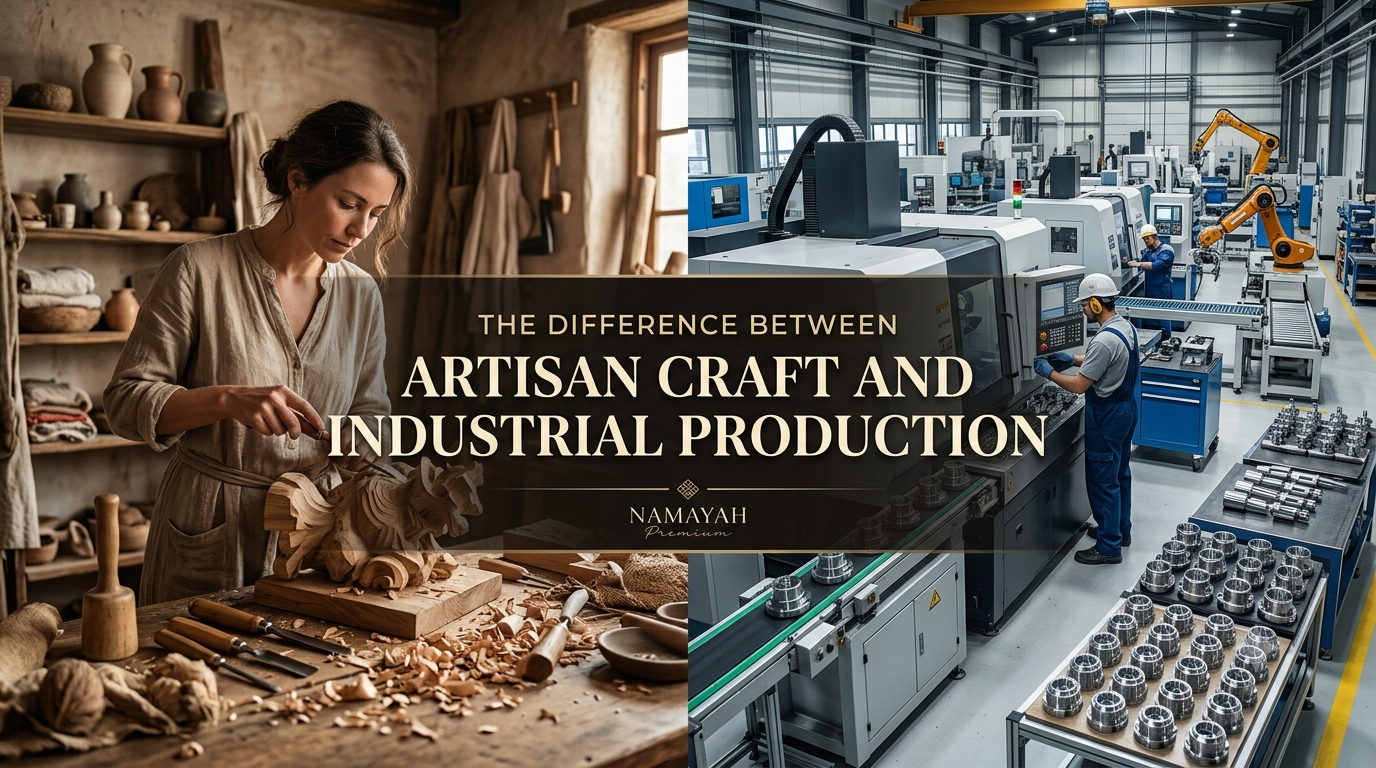
Artisan craft and industrial production represent two different approaches to making goods. Artisan craft relies heavily on skilled human work, traditional techniques, and relatively small-scale production, while industrial production uses machinery, standardized processes, specialized labor, and larger production volumes. Neither approach is automatically better: artisan production often emphasizes individuality and cultural knowledge, while industrial production prioritizes efficiency, consistency, and scale.
The distinction becomes especially important when choosing products, studying manufacturing, evaluating sustainability, or understanding how traditional crafts have changed in an industrial economy.
What Is Artisan Craft?
Artisan craft refers to production in which skilled craftspeople play a central role in designing, shaping, assembling, finishing, or decorating an object.
An artisan may work with materials such as wood, metal, clay, leather, textiles, glass, or natural fibers. The process can involve hand tools, traditional techniques, and some modern equipment. What makes the approach artisanal is not simply that an object is handmade; it is the importance of the maker’s skill, judgment, and knowledge in the production process.
Traditional craftsmanship can also carry cultural significance. UNESCO identifies traditional craftsmanship as one of the domains of intangible cultural heritage and emphasizes the importance of preserving the knowledge and skills involved, not merely the finished objects.
Examples include:
- Hand-thrown pottery
- Handwoven textiles
- Handmade furniture
- Traditional metalwork
- Hand-carved wooden objects
- Handmade jewelry
- Traditional basketry
- Custom leather goods
Artisan production can vary considerably from one workshop or region to another because techniques, materials, and knowledge are often shaped by local traditions and individual makers.
What Is Industrial Production?
Industrial production is the organized manufacture of goods at a larger scale using machinery, standardized processes, specialized labor, technology, and production systems.
Instead of relying primarily on one craftsperson to complete an object from beginning to end, industrial production usually divides the manufacturing process into specialized operations. Machinery and workers perform defined tasks, while quality-control systems help maintain consistent specifications.
Mass production is one important form of industrial production. Its basic advantage is the ability to manufacture large quantities of standardized products efficiently. Specialized tasks and repeatable processes can reduce production time and make large-scale output economically practical.
Industrial production is common in industries such as:
- Automotive manufacturing
- Consumer electronics
- Clothing
- Food processing
- Furniture
- Appliances
- Construction materials
- Packaging
The purpose is generally not to make every item unique. Instead, manufacturers seek predictable specifications, efficient workflows, repeatability, and sufficient output to meet demand.
Artisan Craft vs. Industrial Production
The biggest difference between artisan craft and industrial production is how production is organized and what the production system is designed to prioritize.
| Factor | Artisan Craft | Industrial Production |
|---|---|---|
| Scale | Usually small or limited | Usually medium to very large |
| Main resource | Skilled human labor | Machinery, technology, systems, and labor |
| Output | Limited quantities | Large quantities |
| Product variation | Often natural variation | Usually highly standardized |
| Customization | Generally easier | Often more limited or costly |
| Production speed | Usually slower | Generally faster |
| Unit cost | Often higher | Often lower at scale |
| Cultural value | May preserve traditions and knowledge | Usually focused on commercial production |
| Quality control | Often based on maker expertise plus inspection | Often based on standardized specifications and systems |
| Design flexibility | Often high for small batches | High for engineered changes, but costly at scale |
These are broad distinctions rather than absolute rules. A small workshop can use advanced machinery, and an industrial manufacturer can produce customized products. The boundary between the two approaches is therefore not always rigid.
Production Scale
Scale is one of the clearest differences.
An artisan may produce a relatively small number of pieces because each item requires substantial attention from a skilled maker. Production can therefore be limited by available labor, workspace, materials, and the time required for each piece.
Industrial systems are designed to increase throughput. Standardized components, machinery, production lines, software, and specialized workers can allow manufacturers to produce thousands or millions of units.
This difference explains why industrial goods are often more readily available in large retail markets, while artisan products may be sold in smaller quantities or made to order.
Human Skill and Machinery
Artisan craft places the individual maker’s knowledge at the center of production.
A craftsperson may make repeated decisions throughout the process: selecting a piece of material, adjusting a tool, changing pressure, correcting an irregularity, or modifying a design.
Industrial production distributes these decisions differently. Machines, specifications, production instructions, automation, and quality-control systems can make the manufacturing process more predictable.
This does not mean industrial production eliminates human skill. Engineers, designers, technicians, operators, inspectors, and other specialists can require considerable expertise. The difference is that their expertise is usually integrated into a larger production system rather than concentrated in one maker.
Consistency and Variation
Artisan products can contain small differences from one piece to another. In many cases, these variations are part of their appeal because they demonstrate the influence of the maker and the material.
For example, two handmade ceramic vessels may have slightly different shapes or surface characteristics even when they follow the same design.
Industrial manufacturing generally seeks a narrower range of variation. Standardized measurements, tooling, automation, and inspection help products conform to predetermined specifications.
Consistency is particularly valuable when components must fit together or when consumers expect every unit of a product to function in the same way.
Customization
Artisan production is often well suited to customization.
A craftsperson may adjust dimensions, materials, colors, finishes, or decorative details for an individual customer. Because production volumes are smaller, changes can sometimes be introduced without redesigning an entire manufacturing system.
Industrial production can also offer customization, particularly through modern digital manufacturing and flexible production systems. However, changes can become expensive when they require new tooling, revised processes, different materials, or additional quality-control procedures.
As a result, handmade production is often associated with personalized goods, while industrial production is commonly associated with standardized products.
Cost and Accessibility
Price is another major difference.
Artisan products can cost more because the production process may involve significant skilled labor and fewer units over which costs can be distributed. Materials may also be selected individually, and production may require substantial time.
Industrial production can reduce the cost per unit through scale, specialization, standardized components, automation, and efficient use of equipment.
UNESCO notes that mass production can often supply everyday goods at lower monetary and time costs than hand production, creating a significant competitive challenge for traditional craftspeople.
However, a higher price does not automatically mean an artisan product has better functional performance, just as a lower industrial price does not automatically mean inferior quality. The appropriate choice depends on the purpose of the product.
Cultural and Heritage Value
One of the most important differences concerns the knowledge behind the product.
Traditional craftsmanship can transmit techniques, values, stories, and skills from one generation to another. UNESCO describes intangible cultural heritage as including knowledge and skills transmitted across generations and emphasizes that the living knowledge associated with traditional crafts is particularly important.
An industrially manufactured object may be valuable because of its function, design, engineering, or accessibility. An artisan object can additionally represent a living production tradition.
This distinction is especially important for crafts connected to particular communities or regions. When demand for traditional handmade goods declines, the risk is not only that fewer objects will be produced. Specialized knowledge may also become harder to transmit to future generations.
Advantages of Artisan Craft
Artisan production has several important strengths.
1. Individuality
Handmade products can have distinctive characteristics that differentiate one item from another.
2. Customization
Small-scale production can make personalized sizes, finishes, materials, or designs more practical.
3. Skilled craftsmanship
The process can depend on years of experience and specialized knowledge that cannot always be reduced to a simple production instruction.
4. Cultural connection
Traditional crafts can help maintain cultural knowledge and community identity. UNESCO specifically highlights the importance of transmitting craftsmanship skills and knowledge to future generations.
5. Small-batch flexibility
An artisan can sometimes change designs or techniques quickly without having to alter a large production system.
These strengths make artisan craft particularly attractive for products where uniqueness, personalization, heritage, or maker involvement matters.
Advantages of Industrial Production
Industrial manufacturing offers a different set of strengths.
1. High output
Factories can produce large quantities of goods within relatively short periods.
2. Consistency
Standardized production helps manufacturers create products with predictable dimensions, specifications, and performance.
3. Lower unit costs at scale
Large production volumes can distribute fixed costs across many units and improve production efficiency.
4. Broad availability
Industrial supply chains make standardized products available to large numbers of consumers across different markets.
5. Technological precision
Modern manufacturing can use automation, computer-controlled equipment, sensors, and quality-control systems to achieve levels of repeatability that are difficult to achieve through manual production alone.
Industrial production is therefore particularly useful when society needs large quantities of reliable, standardized goods.
Sustainability and Resource Use
The environmental comparison between artisan and industrial production is more complicated than simply labeling one method sustainable and the other unsustainable.
Artisan production may use local materials, smaller production runs, repair-oriented practices, or techniques that generate less industrial infrastructure. However, traditional production can also consume significant natural resources depending on the material and process.
Industrial production can create environmental pressures because of its scale, energy use, transportation networks, raw-material demand, and waste. At the same time, industrial technology can also improve efficiency, reduce material waste, and make certain manufacturing processes more precise.
UNESCO notes that traditional craftsmanship can itself face environmental pressures, including reduced availability of natural resources used by particular crafts.
The better question is therefore not simply “Which is more sustainable?” but rather:
- What materials are being used?
- How far are they transported?
- How much energy does production require?
- How long does the product last?
- Can it be repaired?
- How much waste is created?
- What happens to the product at the end of its useful life?
A durable artisan product may have a different environmental profile from a disposable industrial product, but comparisons should be based on the complete production and use cycle.
Can Artisan and Industrial Production Work Together?
Yes. The two approaches do not have to exist as complete opposites.
A modern craft business may use computer-aided design, electric tools, digital marketing, or specialized machinery while retaining skilled hand-finishing. Similarly, an industrial manufacturer may use skilled craftspeople for prototyping, finishing, inspection, or specialized components.
Hybrid production can combine the efficiency of technology with the judgment and flexibility of human craftsmanship.
For example, a furniture maker might use computer-controlled equipment to cut standardized components and then rely on skilled workers for assembly and finishing. A jewelry company might use digital design and precision manufacturing while retaining hand-finishing techniques.
This approach recognizes that technology and craftsmanship can complement each other rather than compete in every situation.
How to Choose Between Artisan and Industrial Products
The right option depends on what you value and what the product needs to accomplish.
Choose artisan production when:
- You want a distinctive or personalized product.
- Craftsmanship and maker involvement are important to you.
- You value traditional techniques or cultural heritage.
- You are willing to accept longer production times.
- Small variations between products are acceptable or desirable.
Choose industrial production when:
- You need a product quickly.
- Consistent specifications are important.
- You need large quantities.
- Price and broad availability are major considerations.
- Replacement parts or standardized components matter.
In many cases, there is no universal winner. The two systems solve different production problems.
Frequently Asked Questions
What is the main difference between artisan craft and industrial production?
The main difference is the production system. Artisan craft relies heavily on skilled human work, individual judgment, and often smaller-scale production, while industrial production uses standardized processes, specialized labor, machinery, and larger-scale output.
Are artisan products always handmade?
No. The term artisan generally indicates a strong role for skilled craftsmanship, but artisan producers can use modern tools and equipment. What matters is the role of the craftsperson in the production process.
Why are artisan products often more expensive?
Artisan products may require more skilled labor per item, smaller production runs, longer production times, and individualized material selection or finishing. These factors can increase the cost per unit.
Are industrial products always lower quality?
No. Industrial production is designed to achieve consistency and repeatability, and many industrial products require rigorous engineering and quality control. Whether a product is appropriate or high quality depends on its intended use and specifications.
Which method is better for customization?
Artisan production is often more flexible for individual customization because small batches and direct maker involvement can make changes easier. Industrial manufacturers can also offer customization, especially with flexible manufacturing technologies, but large-scale changes may be more complex.
Why is traditional craftsmanship important?
Traditional craftsmanship can preserve specialized knowledge, skills, techniques, and cultural practices. UNESCO recognizes traditional craftsmanship as a domain of intangible cultural heritage and emphasizes transmitting associated knowledge and skills between generations.
Can industrial manufacturing preserve craftsmanship?
Yes. Industrial businesses can employ skilled craftspeople and incorporate traditional techniques into specialized manufacturing. Technology can also support documentation, training, prototyping, and production without necessarily eliminating craftsmanship.
Is artisan production more sustainable than industrial production?
Not automatically. Sustainability depends on materials, energy use, transportation, durability, repairability, waste, and the entire lifecycle of a product. Both artisan and industrial systems can have environmental advantages and disadvantages.
Conclusion
The difference between artisan craft and industrial production is fundamentally a difference in scale, organization, human involvement, standardization, and purpose.
Artisan craft places skilled makers, individual judgment, customization, and often cultural knowledge at the heart of production. Industrial production emphasizes repeatability, efficiency, technological systems, and the ability to manufacture large quantities of standardized goods.
Neither approach is universally superior. Artisan production can provide individuality, craftsmanship, and cultural continuity, while industrial production makes standardized goods more accessible and scalable. In an increasingly technological economy, the two approaches can also overlap, creating production models that combine modern machinery with human skill.
Understanding this distinction helps consumers, designers, businesses, and students evaluate not only how a product was made, but also what values, resources, skills, and production goals are behind it.