
Machine-Made vs Artisan-Made: Understanding the Difference
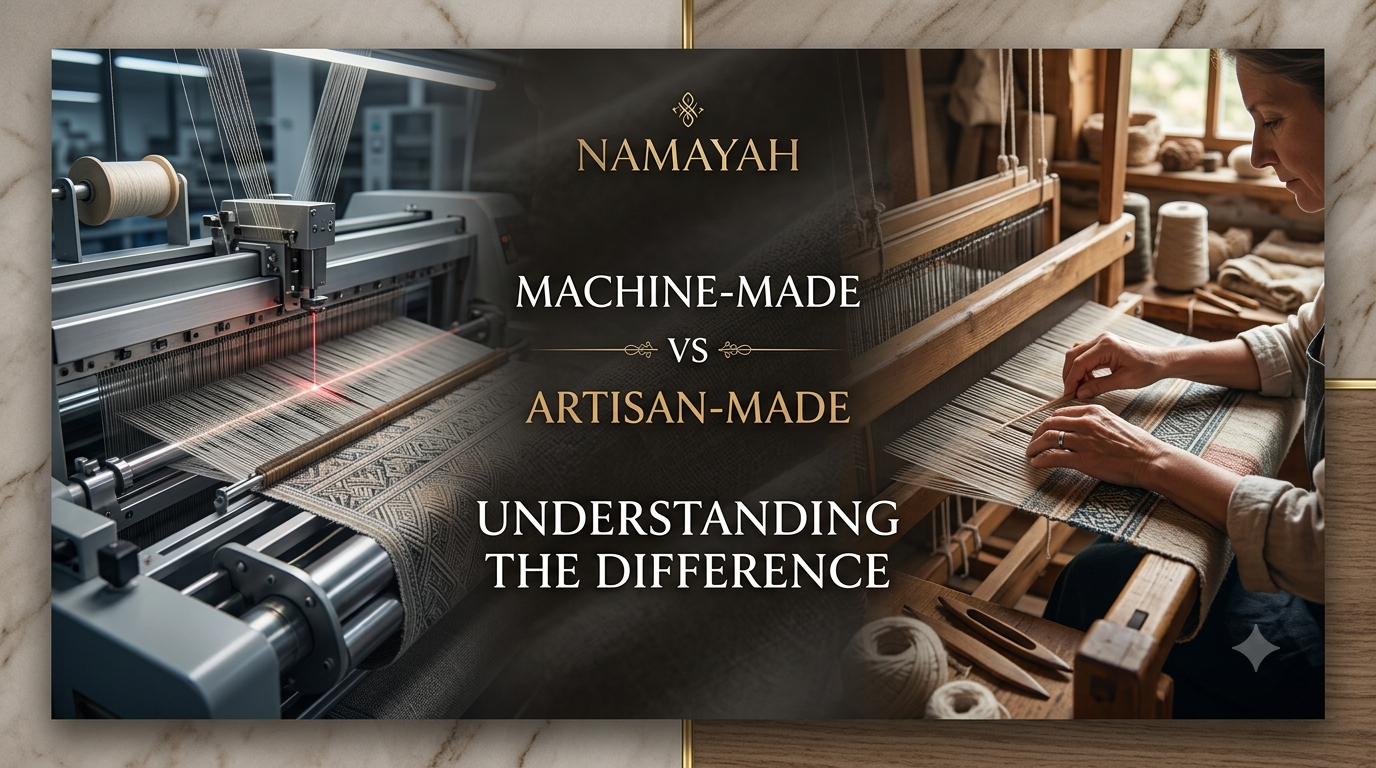
When comparing machine-made vs artisan-made products, the biggest difference is how they are designed, produced, and finished. Machine-made products are generally manufactured with automated or industrial processes that prioritize consistency, efficiency, and scale. Artisan-made products are created primarily through skilled human craftsmanship, often in smaller quantities, with greater variation and attention to individual details.
Neither approach is automatically better for every buyer. The right choice depends on what matters most to you—price, consistency, uniqueness, craftsmanship, durability, customization, or production scale.
What Does Machine-Made Mean?
Machine-made products are manufactured using machinery, automated equipment, standardized processes, or a combination of human labor and industrial technology.
Manufacturers use machines to repeat specific processes accurately and efficiently. This approach is common in industries such as furniture, textiles, ceramics, jewelry, clothing, home décor, and consumer goods.
Key characteristics of machine-made products
- Consistent dimensions and appearance
- Large-scale production
- Faster manufacturing
- Standardized designs
- Greater production efficiency
- Often lower unit costs
- Easier quality control through standardized processes
Machine-made does not necessarily mean low quality. Modern manufacturing can use precise machinery, sophisticated materials, and rigorous quality-control systems to produce highly durable and well-designed products.
What Does Artisan-Made Mean?
Artisan-made products are produced primarily through the skills and techniques of individual craftspeople or small workshops.
An artisan may cut, shape, weave, carve, stitch, paint, mold, or finish an item by hand. Some artisans also use tools and machinery, but the defining feature is the important role of human craftsmanship in creating the finished product.
Key characteristics of artisan-made products
- Significant human involvement
- Traditional or specialized techniques
- Small-batch or individual production
- Greater variation between pieces
- Attention to individual details
- Potential for customization
- Strong connection to the maker or craft tradition
Artisan-made does not necessarily mean that every part of a product is completed entirely by hand. The term generally describes a production approach in which skilled craftsmanship plays a central role.
Machine-Made vs Artisan-Made: Key Differences
| Factor | Machine-Made | Artisan-Made |
|---|---|---|
| Production | Industrial or automated processes | Primarily skilled human craftsmanship |
| Scale | Usually large-scale | Usually small-scale |
| Consistency | Highly consistent | Natural variations are common |
| Production speed | Generally faster | Generally slower |
| Price | Often more accessible | Often higher because of labor and production time |
| Customization | Usually limited | Often more flexible |
| Appearance | Uniform | Individual character may vary |
| Craftsmanship | Process-driven precision | Maker-driven skill and detail |
| Availability | Usually easier to produce in volume | Often limited |
| Personal connection | Usually less direct | Often stronger connection to the maker |
1. Craftsmanship and Human Skill
One of the clearest differences between machine-made and artisan-made products is the role of human skill.
Machines excel at repeating the same operation many times. They can provide precise measurements, consistent shapes, and predictable results.
Artisans, however, can make decisions during production based on the material, design, and desired result. A craftsperson may adjust a technique because a particular piece of wood has a unique grain or because a textile behaves differently during weaving.
This human decision-making can give artisan-made products a distinctive character.
2. Consistency and Variation
Machine-made products are generally designed to look and function consistently.
If a manufacturer produces thousands of identical cups, chairs, garments, or components, buyers typically expect each item to match the established specifications.
Artisan-made products may show subtle differences. A handmade ceramic piece might have a slightly different glaze pattern, while a handwoven textile may contain small variations in texture or color.
For some buyers, these differences are imperfections. For others, they are part of the product’s appeal.
3. Price Differences
Price is another important consideration.
Machine production can distribute manufacturing costs across a large number of products. Automation and standardized processes can also reduce the time required to produce individual units.
Artisan-made products often involve more direct labor per item. The price may reflect the maker’s expertise, production time, materials, design, finishing, and limited production volume.
However, it is inaccurate to assume that every machine-made product is inexpensive or that every artisan-made product is expensive. Materials, brand positioning, design complexity, and market demand also influence price.
4. Uniqueness and Individual Character
If you want products with individual variation, artisan-made goods may be especially appealing.
Because artisans work with materials and make decisions throughout the production process, two pieces from the same maker may not be perfectly identical.
This can be particularly valuable for:
- Handcrafted furniture
- Ceramics
- Jewelry
- Textiles
- Artwork
- Decorative objects
- Traditional crafts
Machine-made products are generally preferable when exact uniformity is important.
5. Quality and Durability
The relationship between production method and quality is more complicated than simply saying “handmade is better.”
A well-designed machine-made product can be highly durable because manufacturing processes can be precisely controlled and tested.
Likewise, an artisan-made product can be exceptionally durable when an experienced craftsperson uses appropriate materials and construction techniques.
When evaluating quality, consider:
- Material quality
- Construction methods
- Workmanship
- Design
- Intended use
- Quality-control standards
- Maintenance requirements
The production method is only one part of the equation.
6. Customization
Artisan-made products may offer more opportunities for personalization.
A customer might be able to request a particular size, finish, material, color, pattern, or design adjustment. Small workshops can sometimes accommodate changes that would be difficult within a highly standardized production system.
Machine-made products can also be customized, particularly in modern manufacturing. However, customization may require different tooling, programming, production runs, or minimum order quantities.
Therefore, the amount of customization available depends on the manufacturer or artisan rather than the production method alone.
7. Production Speed and Availability
Machines are highly effective when large numbers of identical products need to be produced quickly.
For businesses supplying a large market, machine manufacturing can make products widely available and easier to replace.
Artisan production is generally more limited by the amount of time and labor available. A single craftsperson may only be able to create a certain number of pieces in a given period.
This limited availability can be a disadvantage if you need a large quantity quickly, but it can also contribute to the exclusivity of an artisan-made product.
8. Sustainability Considerations
It is tempting to assume that artisan-made automatically means sustainable and machine-made automatically means environmentally harmful. The reality is more complicated.
Environmental impact can depend on:
- Material sourcing
- Energy consumption
- Transportation
- Product lifespan
- Manufacturing waste
- Packaging
- Repairability
- Production volume
- Disposal or recyclability
Small-scale production may reduce some forms of waste, while efficient industrial manufacturing can sometimes use materials and energy more efficiently at scale.
Therefore, buyers should evaluate the actual materials, manufacturing practices, supply chain, and lifespan of a product rather than relying solely on the label “artisan-made.”
9. Cultural and Traditional Value
Artisan-made products can have an important connection to local traditions and specialized craft knowledge.
Traditional weaving, pottery, carving, metalworking, embroidery, woodworking, and other crafts may preserve techniques passed between generations.
Buying directly from responsible artisans or legitimate craft organizations can help support these creative practices.
However, shoppers should also be careful about claims involving cultural heritage. A product described as “traditional” should have credible information about its origin and production rather than relying solely on marketing language.
10. Repairability and Longevity
Repairability depends heavily on the individual product.
Some artisan-made goods can be repaired or restored by the original maker or another skilled craftsperson. Their relatively simple construction may also make certain repairs practical.
Machine-made products vary widely. Some are designed with replaceable components, while others may be difficult or uneconomical to repair.
Before purchasing, consider whether replacement parts, repair services, maintenance instructions, or the maker’s support are available.
11. Which Is Better: Machine-Made or Artisan-Made?
There is no universal winner in the machine-made vs artisan-made comparison.
Choose machine-made when you prioritize:
- Consistent appearance
- Large quantities
- Fast availability
- Standardized specifications
- Lower or predictable costs
- Easy replacement
Choose artisan-made when you prioritize:
- Human craftsmanship
- Individual character
- Small-batch production
- Customization
- Traditional techniques
- A closer connection to the maker
The best option depends on the purpose of the purchase.
Machine-Made vs Artisan-Made: A Simple Example
Imagine buying a dining chair.
A machine-made chair may be produced according to standardized specifications. Every chair in the collection can have nearly identical dimensions, finishes, and components.
An artisan-made chair may be individually shaped, assembled, and finished by a craftsperson. Small differences in the wood grain, joinery, or finish may make each chair slightly different.
If you are furnishing hundreds of identical rooms, consistency and availability may be more important.
If you are buying one statement piece for your home, individuality and craftsmanship may matter more.
How to Tell If a Product Is Truly Artisan-Made
The term “artisan-made” can mean different things depending on the seller and industry. Instead of relying only on a product label, ask questions such as:
- Who made the product?
- Where was it made?
- Which parts were handmade?
- What materials were used?
- Is the product made in small batches?
- Can the maker explain the production process?
- Are variations between pieces expected?
- Can the product be repaired or customized?
A transparent seller should be able to provide meaningful information about the product’s origin and production process.
What Should You Consider Before Buying?
Before choosing between machine-made and artisan-made products, create a simple priority list.
Choose based on your needs
For consistency: Machine-made may be the better fit.
For uniqueness: Artisan-made may be more suitable.
For large quantities: Machine-made production is usually more practical.
For customization: Look for an artisan or manufacturer that explicitly offers customization.
For craftsmanship: Research the maker’s techniques, experience, and materials.
For sustainability: Investigate actual environmental practices rather than assuming sustainability from the production label.
For value: Compare materials, construction, longevity, service, and price—not just whether the item is handmade.
Frequently Asked Questions
Is artisan-made the same as handmade?
Not always. “Handmade” generally emphasizes the role of handwork, while “artisan-made” emphasizes skilled craftsmanship and the maker’s expertise. Definitions can vary by industry and seller.
Are artisan-made products better quality?
Not automatically. Artisan-made products can demonstrate exceptional craftsmanship, but quality depends on materials, construction, design, workmanship, and intended use.
Are machine-made products lower quality?
No. Machine-made products can be precisely engineered, consistently manufactured, and highly durable. Industrial production can support strict quality-control processes.
Why are artisan-made products often more expensive?
They may require more skilled labor and production time per item and may be produced in smaller quantities. Materials, design, brand positioning, and the maker’s expertise can also affect the price.
Can machine-made products be customized?
Yes. Some manufacturers offer extensive customization using modern manufacturing technologies. The available options depend on the manufacturer and production system.
Do artisan-made products have imperfections?
They can have small variations resulting from manual production and natural materials. Whether these differences are considered imperfections or desirable characteristics depends on the product and buyer.
Is artisan-made more sustainable?
Not necessarily. Sustainability depends on materials, energy use, waste, transportation, product lifespan, repairability, and other factors. The production method alone does not determine environmental impact.
How can I verify an artisan-made product?
Look for transparent information about the maker, location, production process, materials, and degree of handwork. Ask the seller specific questions if the description is unclear.
Conclusion
Understanding machine-made vs artisan-made products helps you make more informed purchasing decisions. Machine manufacturing emphasizes consistency, efficiency, scalability, and standardized production, while artisan production places greater emphasis on human skill, individual character, and craftsmanship.
Neither approach is inherently superior. A machine-made product can offer excellent precision and value, while an artisan-made product can provide distinctive character and a strong connection to the craftsperson who created it.
The smartest choice is to look beyond the label. Consider the product’s materials, construction, purpose, durability, price, production practices, and the qualities that matter most to you.