
Luxury Decorating Mistakes to Avoid
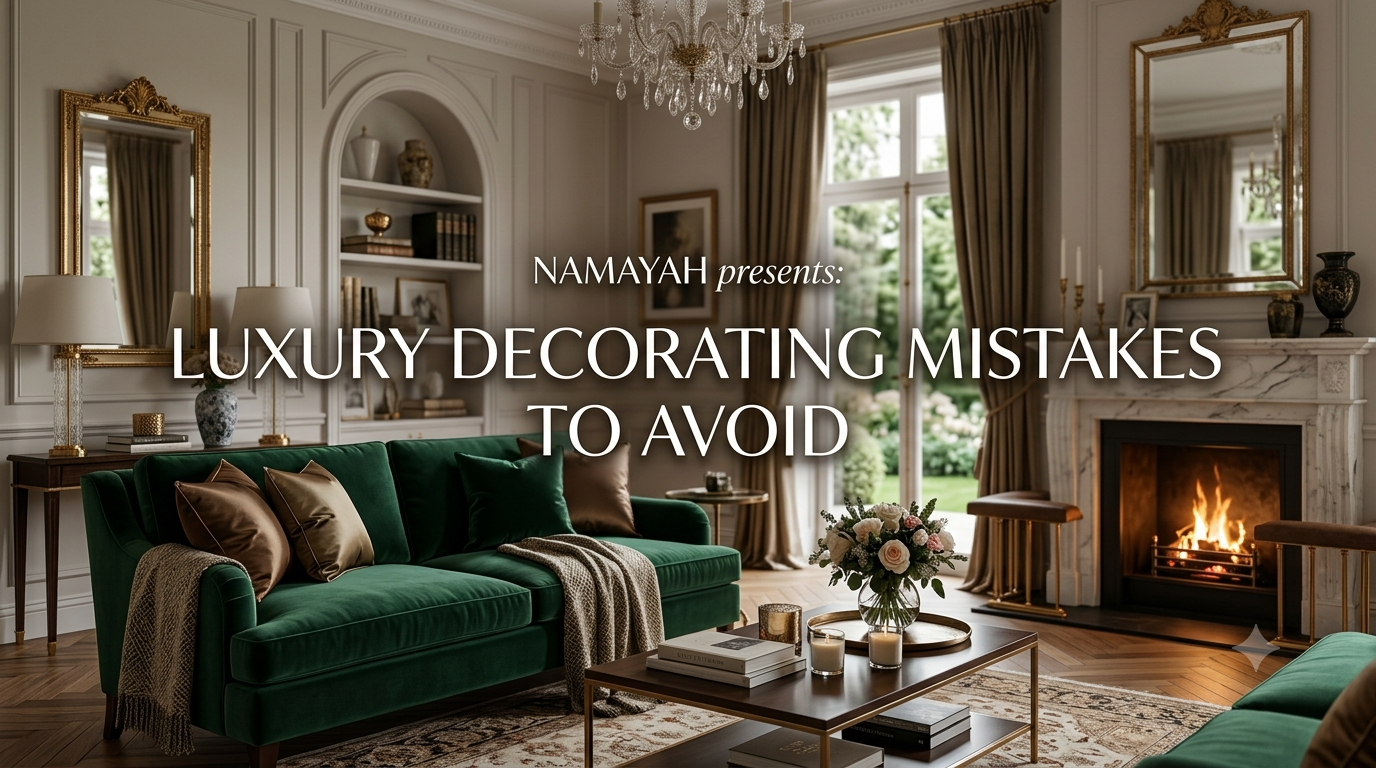
Creating a luxurious home is not simply a matter of buying expensive furniture, choosing marble surfaces, or adding statement lighting. The most convincing high-end interiors usually depend on proportion, quality, restraint, comfort, thoughtful lighting, and personal character.
That is also why decorating mistakes can be surprisingly noticeable in luxury interiors. An undersized rug can make beautiful furniture feel disconnected. Poor lighting can flatten expensive materials. Too many statement pieces can compete rather than complement one another.
Recent advice from interior designers reinforces the importance of scale, layered lighting, furniture placement, and thoughtful rather than perfectly matched decoration.
Here are 12 luxury decorating mistakes to avoid if you want your home to feel refined, comfortable, and intentionally designed.
1. Assuming Expensive Means Luxurious
One of the biggest mistakes is confusing price with good design.
An expensive sofa, designer chandelier, rare stone table, and collectible artwork can all be beautiful individually. Put them together without considering proportion, color, texture, architecture, or function, however, and the room may still feel disjointed.
Luxury is more convincing when every element has a purpose.
Instead of asking, “What is the most expensive option?” ask:
- Does it suit the room?
- Is the material appropriate for its use?
- Does it complement what I already own?
- Will I still appreciate it after the trend changes?
- Does it improve comfort or function?
A carefully chosen vintage chair may contribute more character than an entire matching collection of costly new furniture.
2. Ignoring Scale and Proportion
Poor scale is one of the fastest ways to make an otherwise beautiful room feel wrong.
A tiny coffee table beside a huge sectional looks disconnected. An enormous chandelier can overwhelm a compact dining room, while undersized artwork may appear lost above a long sofa.
Designers frequently identify scale and proportion as decorating issues. Measuring and planning furniture placement before purchasing major pieces can reduce these problems.
Before buying furniture, measure:
- Room dimensions
- Ceiling height
- Doorways and circulation paths
- Existing furniture
- Wall space
- Distance between major pieces
Consider the relationships between objects rather than judging each object separately.
Luxury comes from composition, not size.
3. Using a Rug That Is Too Small
An undersized rug is a particularly common decorating mistake.
A small rug floating beneath a coffee table can visually separate the seating rather than unify it. Designers interviewed by The Spruce similarly identified too-small rugs as a frequent problem because they can disrupt proportion and furniture placement.
A rug should generally feel substantial enough to anchor the furniture arrangement.
For a living room, that may mean choosing a rug large enough to connect the primary seating pieces rather than leaving it isolated in the middle.
In a dining room, consider what happens when the chairs are pulled away from the table. The rug needs to work with the furniture in use—not merely when everything is perfectly arranged.
If you already own a beautiful rug that is too small, layering it over a larger neutral foundation can sometimes create better proportions.
4. Relying on One Lighting Source
Even excellent interiors can look flat under poor lighting.
One harsh overhead fixture rarely creates the depth associated with sophisticated rooms. Architectural Digest’s recent guidance recommends using several sources at different heights rather than depending entirely on ceiling lighting.
A more considered lighting plan combines different functions:
| Lighting Type | Purpose | Examples |
|---|---|---|
| Ambient | General illumination | Chandeliers, ceiling fixtures |
| Task | Supports activities | Reading lamps, desk lamps |
| Accent | Highlights features | Picture lights, directional lighting |
| Decorative | Adds visual character | Sculptural lamps, pendants |
Sconces, table lamps, floor lamps, pendants, picture lights, and architectural lighting can work together to create layers.
The goal is not maximum brightness. It is appropriate illumination, atmosphere, and visual depth.
5. Buying Matching Furniture Sets
Perfect matching can make a home look more like a showroom than a thoughtfully developed interior.
Buying a bed, dresser, nightstands, and bench from one identical collection may be convenient, but luxury interiors often benefit from a more collected appearance.
This does not mean combining random pieces.
Look for coordination rather than duplication.
For example, a bedroom might combine an upholstered bed, timber nightstands, an antique-inspired dresser, contemporary lamps, and a textured bench. A repeated color, material, silhouette, or finish can provide continuity.
Designers have likewise warned that matching furniture sets can reduce individuality and make spaces feel less personal.
6. Overdecorating the Room
Luxury does not require filling every available surface.
Too many accessories can prevent individual objects from having visual impact. If every wall contains artwork, every table holds several ornaments, and every chair has multiple cushions, the eye has nowhere to rest.
Use negative space deliberately.
Instead of displaying ten decorative objects on a console, try a smaller composition involving:
- One substantial artwork or mirror
- A sculptural object
- Books
- A lamp
- A restrained natural element
Editing does not necessarily mean minimalism. Maximalist luxury can be highly layered and expressive, too. The important distinction is between intentional layering and uncontrolled clutter.
Recent design commentary emphasizes balancing meaningful objects, foundational pieces, and statement elements rather than simply accumulating beautiful things.
7. Choosing Appearance Over Comfort
A home should not become uncomfortable in pursuit of sophistication.
An elegant sofa that is unpleasant to sit on, a dining chair that cannot support a long meal, or a pristine living room nobody is allowed to use undermines the purpose of residential design.
Luxury should improve daily life.
Before buying major furniture, consider:
Comfort + durability + function + appearance.
Think about who actually uses the room. A household with children or pets may require different fabrics and finishes from a formal residence used primarily for entertaining.
The best choice is not necessarily the most delicate one. It is the material that delivers the desired appearance while still performing appropriately.
8. Following Too Many Trends
Trends can make interiors interesting, but building an entire room around short-lived trends creates a risk of rapid visual aging.
Instead, separate your design into foundations and flexible layers.
Invest more carefully in long-term elements such as:
- Flooring
- Built-in cabinetry
- Major furniture
- Architectural details
- Quality stone
- Important lighting
Experiment more freely with cushions, throws, accessories, smaller lamps, decorative objects, and easily changed colors.
This approach lets your home evolve without requiring a major redesign whenever tastes shift.
Timeless does not mean boring. It means the room’s success does not depend entirely on what happens to be fashionable this year.
9. Neglecting Curtains and Window Treatments
Beautiful windows can lose impact when treatments look unfinished or poorly proportioned.
Curtains influence perceived height, softness, acoustics, privacy, light control, and the overall visual composition of a room. Poorly installed curtains are among the details designers notice in otherwise finished interiors.
Pay attention to:
- Curtain length
- Fabric fullness
- Rod placement
- Hardware
- Lining
- How fabric hangs
- Relationship to architectural details
Window treatments should look intentional whether they are understated linen panels or more formal custom drapery.
10. Forgetting Texture and Material Contrast
A neutral palette can look sophisticated, but neutral does not mean uniform.
Imagine a room containing cream walls, a cream sofa, cream curtains, a cream rug, and cream cushions—all in similar flat textures. The palette may be cohesive, yet the result can lack dimension.
Instead, layer materials.
You might combine smooth stone with textured linen, warm timber with metal, wool with glass, plaster with velvet, or polished surfaces with matte finishes.
Texture becomes especially important when the color palette is restrained because subtle differences in surface, weave, sheen, and material give the eye something to explore.
The objective is contrast without chaos.
11. Poor Furniture Placement
Pushing every piece of furniture against a wall is not always the best way to make a room feel spacious.
In larger rooms, it can create an empty central area while making conversation difficult. Architectural Digest specifically identifies automatically pushing furniture against walls as a common living-room layout problem.
Where space permits, create purposeful furniture groupings.
A sofa, two chairs, rug, and coffee table can form a defined conversation area. In an open-plan home, furniture placement can also establish distinct zones without requiring walls.
Always preserve comfortable circulation.
A luxurious room should be easy to navigate, not simply attractive from one camera angle.
12. Forgetting Personality
Perhaps the most important luxury decorating mistake is creating a home that could belong to anyone.
Following a showroom, hotel, Pinterest board, or catalog too closely may produce a polished result, but it can remove the individuality that makes interiors memorable.
Incorporate pieces with personal relevance:
- Original artwork
- Books you actually read
- Travel finds
- Family pieces
- Vintage furniture
- Handmade objects
- Collections
- Locally crafted items
Not everything needs to be valuable in financial terms.
A meaningful inherited object beside contemporary furniture can sometimes create more character than another expensive accessory.
The objective is a home that looks collected rather than purchased all at once.
Luxury Decorating Mistakes: Quick Reference
| Mistake | Better Approach |
|---|---|
| Equating price with luxury | Prioritize quality, suitability, and composition |
| Wrong furniture scale | Measure and plan before purchasing |
| Rug too small | Use the rug to anchor the furniture |
| One overhead light | Layer multiple light sources |
| Matching furniture sets | Coordinate complementary pieces |
| Too many accessories | Edit and create visual breathing room |
| Appearance over comfort | Balance beauty with function |
| Excessive trends | Invest in timeless foundations |
| Poor window treatments | Consider proportion and finish |
| Flat neutral scheme | Layer textures and materials |
| Furniture against every wall | Create purposeful groupings |
| No personal elements | Add meaningful, collected pieces |
FAQs About Luxury Decorating Mistakes
What makes a house look luxurious?
A luxurious home generally feels cohesive, comfortable, well proportioned, and thoughtfully finished. Quality materials, layered lighting, suitable furniture, carefully selected artwork, good craftsmanship, and attention to detail can contribute more than simply filling the home with expensive products.
What decorating mistakes can make a home look cheap?
Common problems include poor proportions, undersized rugs, harsh lighting, excessive clutter, visibly low-quality finishes, badly fitted window treatments, matching furniture sets, and too many competing statement pieces.
What is the biggest mistake when decorating a luxury living room?
There is no universal single mistake, but poor scale and proportion can affect nearly everything else. Furniture, rugs, lighting, artwork, and accessories need to relate appropriately to both the room and one another.
How can I make my home look luxurious without spending a lot?
Focus on editing, furniture arrangement, consistent finishes, good lighting, correctly scaled rugs, window treatments, and a restrained palette. Improving presentation and proportion can make a substantial visual difference without replacing everything.
Should all furniture match in a luxury interior?
No. Furniture can coordinate without being identical. Mixing complementary materials, periods, colors, and silhouettes often creates a more collected and personal appearance than purchasing an entire matching set.
What colors make a home look luxurious?
There is no single luxury color palette. Warm neutrals, rich earth tones, deep greens, blues, dark woods, and restrained monochromatic schemes can all work. Material quality, lighting, contrast, and composition matter as much as the colors themselves.
Can you have too much luxury decor?
Yes. When too many dramatic materials, patterns, statement lights, artworks, and decorative objects compete simultaneously, individual pieces lose impact. Luxury interiors can be richly layered, but the layers should have a clear visual relationship.
How do I make a luxury home feel warm instead of like a hotel?
Introduce personal artwork, books, vintage or inherited objects, natural materials, textiles, warm lighting, and pieces collected over time. Personal history helps distinguish a home from an intentionally generic hospitality interior.
Conclusion
Avoiding luxury decorating mistakes is less about following rigid rules and more about making deliberate decisions.
Start with scale and function. Invest thoughtfully in foundational pieces, layer the lighting, choose an appropriately sized rug, mix complementary furniture instead of relying on sets, and give important objects enough space to stand out.
Most importantly, leave room for personality.
A successful luxury interior should not merely communicate what was spent on it. It should feel comfortable, cohesive, distinctive, and appropriate for the people who live there.