
How to Build a Cohesive Home Décor Theme
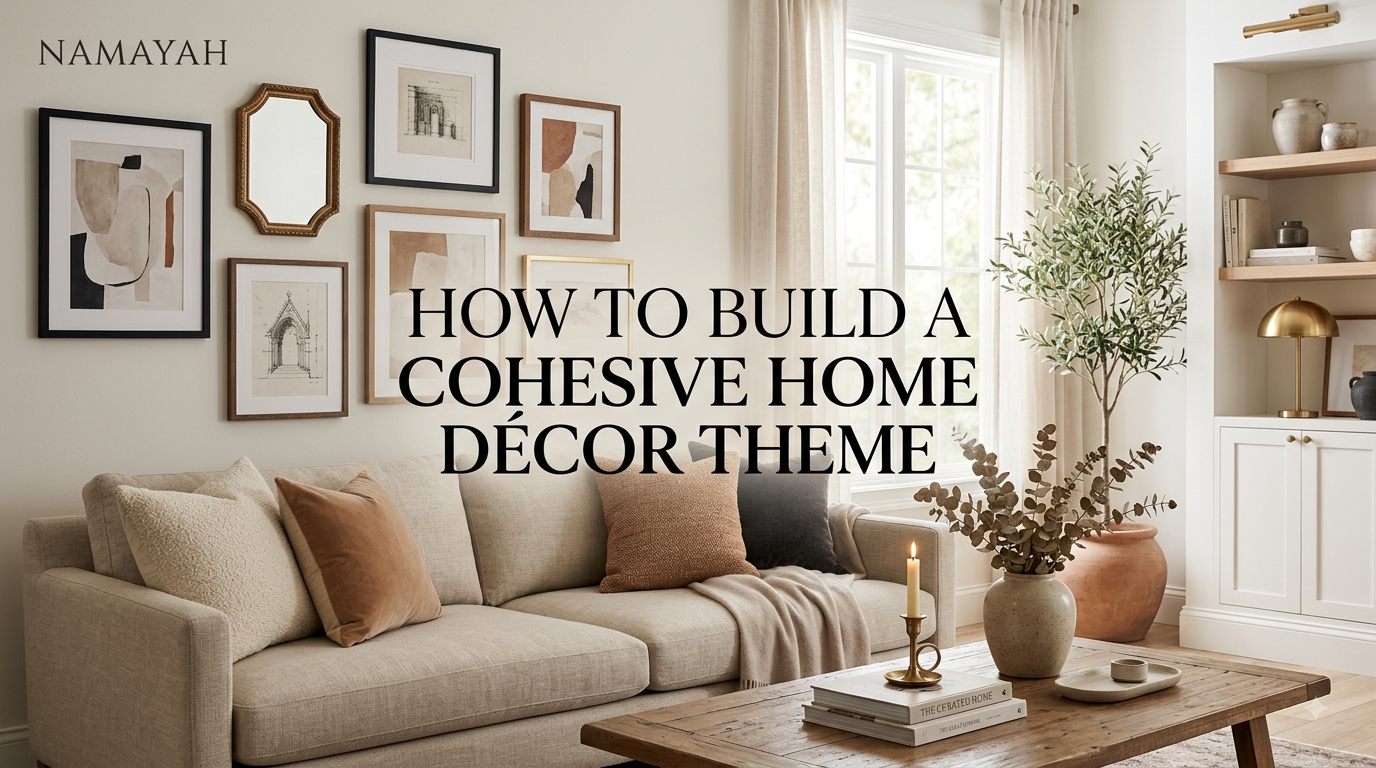
Creating a beautiful home is not necessarily about making every room look the same. The goal is to make each space feel like part of the same home. A cohesive home décor theme uses recurring colors, materials, shapes, textures, and design details to create visual connection while allowing each room to retain its own personality.
The easiest approach is to choose a clear overall direction, establish a flexible color palette, repeat a few important elements, and make intentional choices when moving from one room to another. Current interior-design guidance similarly emphasizes continuity rather than identical rooms.
What Is a Cohesive Home Décor Theme?
A cohesive home décor theme is a consistent visual language that connects different rooms.
For example, your living room could be warm and relaxed, your dining room could be more formal, and your bedroom could feel calm and private. They do not need identical furniture or paint colors. Instead, they might share:
- Similar warm undertones
- A recurring wood finish
- Complementary accent colors
- Consistent metal finishes
- Related furniture shapes
- Repeated fabrics or textures
- Similar lighting styles
Think of your home as a story. Each room is a different chapter, but the same visual ideas should connect them.
Cohesion also does not mean buying matching furniture sets. A home can actually feel more personal when different pieces are thoughtfully combined rather than purchased as a single collection.
Start With a Clear Design Direction
Before buying new décor, decide what you want your home to feel like.
You might prefer:
- Warm and inviting
- Modern and minimalist
- Traditional and elegant
- Organic and nature-inspired
- Coastal and relaxed
- Eclectic and collected
- Contemporary and sophisticated
- Rustic and comfortable
You do not have to follow one design style perfectly. In fact, combining a dominant style with a secondary influence can create a more personal result.
For example, you might choose modern + organic or traditional + contemporary.
Create a simple mood board using photographs, fabric samples, paint colors, furniture ideas, and artwork. Then look for patterns in what you have selected.
Ask yourself:
What colors keep appearing? What materials do I prefer? Are the shapes mostly curved or straight? Does the space feel warm, cool, formal, casual, or somewhere between?
These answers become your design filter.
Create a Whole-Home Color Palette
Color is one of the easiest ways to create continuity.
You do not need to use the exact same color in every room. Instead, establish a broader palette and interpret it differently in each space. This approach allows rooms to have individual identities while still feeling related.
A practical palette could contain:
- One or two base colors for large surfaces
- One or two supporting colors for furniture and textiles
- One or two accent colors for smaller decorative elements
- Natural tones from wood, stone, plants, or woven materials
For example, a warm neutral palette could include cream, beige, muted green, natural wood, and small amounts of black.
The living room might emphasize green, while the bedroom uses more cream and natural wood. Repeating a smaller amount of green in the bedroom can still connect the two spaces.
Pay Attention to Undertones
Two colors can look completely different when their undertones clash.
Warm whites generally work better with other warm colors, while cooler whites can complement cooler palettes. Test paint and large samples in your actual rooms because natural and artificial light can change how colors appear. Designers also recommend evaluating colors in the space rather than relying only on small samples or screens.
Choose a Dominant Material or Wood Tone
Color is not the only way to connect rooms. Materials can create an equally strong visual thread.
Consider which finishes appear throughout your home:
- Light or dark wood
- Natural stone
- Marble
- Rattan
- Linen
- Ceramic
- Glass
- Black metal
- Brass
- Brushed nickel
You do not have to use one material everywhere. Instead, repeat related finishes often enough that the rooms feel connected.
For example, if your living room has warm oak furniture, you could introduce a similar wood tone in the dining area and bedroom.
The repetition can be subtle. The goal is recognition, not uniformity.
Repeat Colors, Shapes, and Finishes
Repetition is one of the most effective tools for cohesive décor.
You can repeat:
- A particular accent color
- A wood tone
- A metal finish
- Curved furniture shapes
- Arched details
- Geometric patterns
- Natural textures
- Similar artwork styles
Suppose your living room has a curved coffee table. You could echo that shape with a rounded mirror in the hallway or a curved lamp in the bedroom.
Likewise, if black hardware appears in the kitchen, a few black accents elsewhere can create continuity.
The repetition should feel natural rather than obvious.
Balance Furniture Styles
A common reason a home feels disconnected is that furniture is selected room by room without considering the larger picture.
That does not mean every chair, table, and sofa must match.
Instead, consider the visual weight and character of your furniture.
A modern sofa can work with a vintage coffee table if both pieces connect through color, material, proportion, or shape. Similarly, traditional furniture can work in a contemporary home when it is balanced with simpler pieces.
A useful rule is to choose one dominant furniture language and introduce contrasting pieces selectively.
This creates variety without visual chaos.
Use Texture to Add Depth
A cohesive home should not be flat or overly uniform.
Texture adds depth while helping different materials work together. Recent design coverage has highlighted layered interiors that combine materials such as linen, velvet, woven elements, wood, and other tactile surfaces to create warmth and character.
Try combining:
- Smooth surfaces with rough finishes
- Soft textiles with hard materials
- Woven baskets with polished furniture
- Linen with wood
- Wool rugs with metal accents
- Ceramic objects with glass
Texture is particularly useful when your color palette is restrained. A neutral room can still feel rich when it contains several different textures.
Coordinate Lighting
Lighting is often treated as a practical necessity, but it is also an important part of your décor theme.
Start by considering the overall style of your fixtures.
For a modern home, you might favor simple fixtures with clean lines. A traditional home might use more decorative silhouettes. An eclectic home could combine several styles while maintaining a common material or finish.
Layer your lighting with:
- Ceiling fixtures
- Floor lamps
- Table lamps
- Wall sconces
- Accent lighting
- Task lighting
Using multiple types of lighting can add depth and atmosphere rather than relying on a single overhead fixture.
Try to repeat finishes where appropriate. For example, brass lighting fixtures in one room can be echoed through brass hardware or smaller decorative details elsewhere.
Use Rugs and Flooring as Anchors
Floors cover a large visual area, so they can strongly influence whether your décor feels connected.
You do not necessarily need identical flooring throughout the home. What matters is whether adjacent materials and finishes work together.
Consider:
- Warm versus cool undertones
- Wood color
- Flooring pattern
- Finish level
- Transition points between rooms
Rugs can also help connect furniture and color palettes.
A rug in the living room might combine three colors used elsewhere in the home. That creates a subtle bridge between the furniture, walls, accessories, and adjoining spaces.
Connect Rooms Without Making Them Identical
One of the biggest misconceptions about cohesive home décor is that every room should look the same.
It should not.
Instead, think about shared elements with different expressions.
For example:
| Shared Element | Living Room | Bedroom | Dining Room |
| Accent color | Olive green cushions | Olive throw | Olive artwork |
| Wood tone | Coffee table | Bedside tables | Dining table |
| Metal | Black lamp | Black mirror frame | Black cabinet hardware |
| Texture | Wool rug | Linen bedding | Woven chairs |
This approach gives each room a distinct purpose while maintaining a common design language.
Add Artwork and Personal Accessories
Your home should look like it belongs to you, not like a showroom.
Use artwork, books, photographs, travel objects, heirlooms, plants, and collected pieces to add personality.
The key is editing.
Before placing an accessory, ask:
- Does it fit the overall palette?
- Does it support the room’s mood?
- Does it have personal meaning?
- Does it work with the scale of nearby objects?
- Does the room actually need it?
A mix of old and new pieces can make an interior feel more individual and lived-in rather than overly coordinated. Recent advice from interior designers has emphasized the value of combining newer pieces with vintage, inherited, or meaningful objects.
Common Mistakes That Break Cohesion
Even attractive décor can feel disconnected when a few common problems appear.
Using Too Many Unrelated Colors
If every room introduces a completely different palette, the home can lose its visual connection.
Matching Everything
The opposite problem is making every room identical. Excessive matching can make a home feel predictable rather than cohesive.
Mixing Too Many Styles
Eclectic design can work beautifully, but it still benefits from a unifying element such as color, material, era, or shape.
Ignoring Scale
A tiny accessory on a large table or an oversized piece in a small room can disrupt visual balance.
Following Trends Without a Plan
Trendy pieces can be useful, but buying them individually without considering your existing décor can create a collection of unrelated styles.
Overdecorating
More objects do not automatically create a richer room. Leaving some negative space can help important pieces stand out and make the overall composition easier to read.
A Simple Room-by-Room Process
If your home currently feels disconnected, you do not need to replace everything.
Use this process instead.
Step 1: Photograph each room.
Look at your home from a distance rather than judging individual objects.
Step 2: Identify what already works.
Choose your favorite colors, materials, furniture pieces, and artwork.
Step 3: Remove obvious mismatches.
Temporarily store pieces that strongly conflict with your preferred direction.
Step 4: Build your palette.
Choose your base, supporting, and accent colors.
Step 5: Select recurring elements.
Choose two or three elements to repeat, such as a wood tone, metal finish, or accent color.
Step 6: Improve transitions.
Look at spaces that can be seen together and make sure their colors and materials relate.
Step 7: Add texture.
Introduce rugs, curtains, cushions, throws, baskets, plants, and other tactile elements.
Step 8: Personalize the rooms.
Finish with artwork, books, photographs, and objects that have meaning.
Step 9: Edit.
Walk through the home and remove anything that feels unnecessary or unrelated.
The most important step is to design the home as a whole rather than treating every room as an isolated project.
FAQ About Cohesive Home Décor
How do I make my home décor look cohesive?
Choose a clear design direction and repeat a few elements throughout the home. Consistent colors, materials, wood tones, shapes, and finishes can connect rooms without making them identical.
Should every room in a house match?
No. Each room can have its own personality and function. The goal is to create relationships between rooms through shared colors, materials, shapes, textures, or finishes.
How many colors should a home décor palette have?
There is no universal number, but a simple starting point is one or two base colors, supporting tones, and a small number of accents. The important factor is how the colors relate rather than a strict color count.
How do you mix different décor styles?
Choose one dominant style and use another style as an accent. Connect contrasting pieces through color, material, scale, shape, or finish.
What is the easiest way to create a cohesive home?
Start with the elements that are hardest to change, such as flooring and major furniture. Then build your color palette and repeat selected materials and accents throughout the home.
Can a colorful home still look cohesive?
Yes. A colorful home can feel cohesive when its colors have a clear relationship. Repeating selected colors in different rooms can create continuity without making every space look the same.
How can I make my home cohesive without buying new furniture?
Start by rearranging, editing, and grouping what you already own. Remove pieces that conflict with your preferred style, move complementary items between rooms, and use textiles, artwork, and accessories to introduce repeated colors and materials.
How do you make an open-plan home feel cohesive?
Use a consistent color palette and related materials across the connected areas. Rugs, lighting, furniture arrangement, and repeated finishes can also define individual zones while maintaining visual continuity.
Conclusion
Building a cohesive home décor theme is less about matching everything and more about making intentional connections.
Start with a clear design direction. Develop a flexible color palette, choose recurring materials, repeat a few shapes or finishes, and use lighting, rugs, artwork, and texture to connect the rooms. At the same time, leave enough freedom for each space to reflect its purpose and your personality.
The best cohesive homes usually feel connected without feeling copied. Your goal is not to make every room identical. It is to create a home where each room belongs to the same story.