
Green Living with Natural Materials
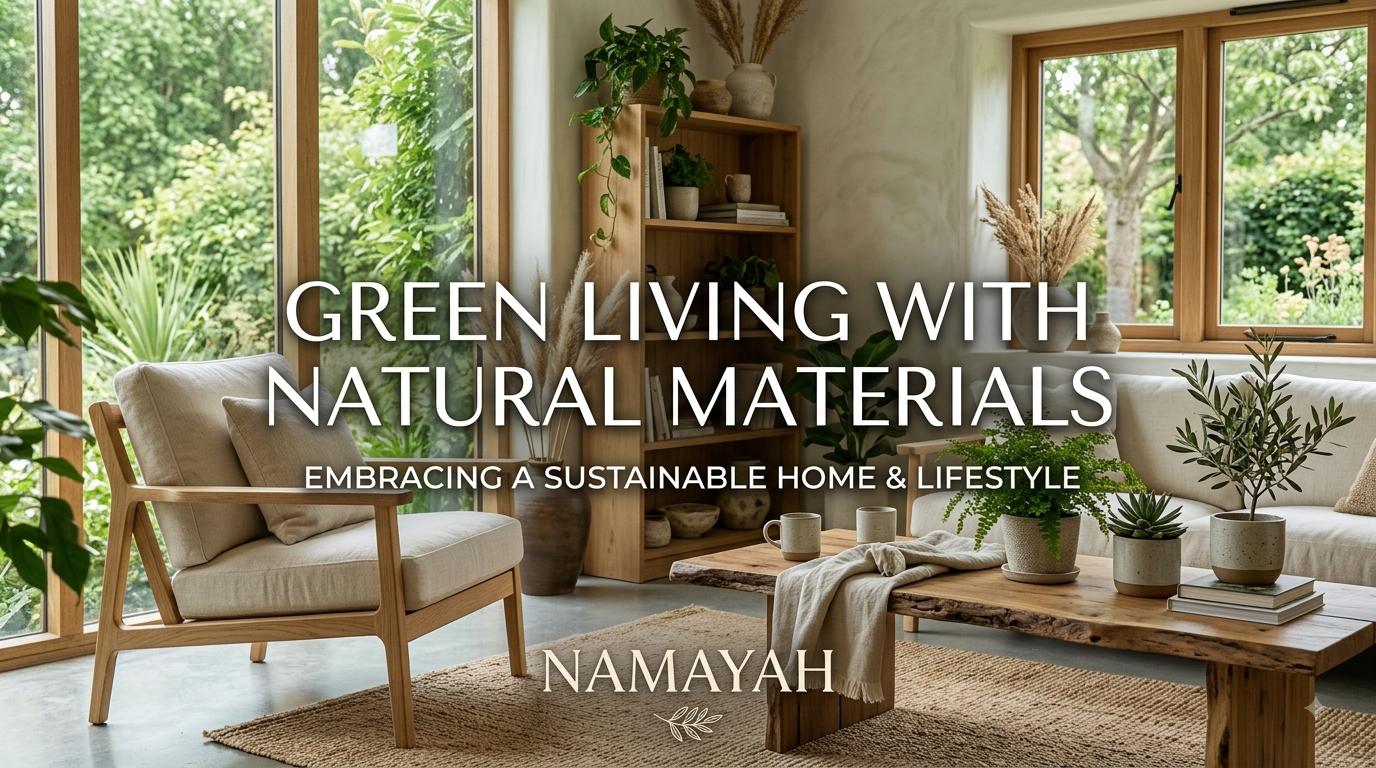
Green living with natural materials is about making thoughtful choices about what surrounds us at home—from floors and furniture to insulation, walls, finishes, bedding, and everyday household products. Materials such as responsibly sourced wood, bamboo, cork, clay, lime, hemp, wool, and other natural fibers can help create comfortable spaces while reducing reliance on some highly processed materials.
However, natural does not automatically mean sustainable. A responsible choice depends on factors such as sourcing, durability, processing, transportation, maintenance, and what happens to the material at the end of its useful life.
What Is Green Living With Natural Materials?
Green living with natural materials means choosing materials derived primarily from renewable, mineral, agricultural, or biological sources while considering their environmental impact throughout their life cycle.
Instead of focusing only on whether a material is labeled “natural” or “eco-friendly,” consider the bigger picture:
- Where did the material come from?
- How quickly can the resource regenerate?
- How much processing does it require?
- How far does it need to travel?
- How long will it last?
- Does it require chemical treatments or coatings?
- Can it be repaired, reused, recycled, or safely disposed of?
- Is it appropriate for the climate and application?
This approach makes green living more practical. The goal is not to create a home containing only natural materials. The goal is to make better-informed choices that balance environmental impact, performance, safety, durability, cost, and local availability.
Why Natural Materials Matter for Sustainable Living
The materials used inside a home can affect more than its appearance. Building materials, furnishings, consumer products, temperature, humidity, and ventilation can all influence indoor air quality. The U.S. Environmental Protection Agency identifies building materials and furnishings among potential indoor sources of pollutants, including volatile organic compounds (VOCs).
Choosing lower-emission products can therefore be one consideration when creating a healthier indoor environment. EPA’s Indoor AirPlus program, for example, includes low-emission materials and low-VOC paints, carpets, and certain manufactured wood products as part of its indoor-air-quality approach.
Natural materials can also bring other potential benefits:
- Renewable sourcing: Some plant-based materials can regenerate relatively quickly when responsibly managed.
- Durability: Long-lasting materials can reduce the frequency of replacement.
- Repairability: Certain natural products can be repaired or refinished instead of discarded.
- Aesthetic value: Wood, stone, clay, cork, and natural fibers can add texture and warmth.
- Local availability: Locally sourced materials may reduce transportation requirements, although this depends on the specific product and supply chain.
- Material transparency: Some natural materials have relatively straightforward compositions, making their origin easier to understand.
Still, every material needs to be evaluated individually. A natural product that travels thousands of kilometers, requires intensive processing, or has a short service life may not be the best environmental choice.
8 Natural Materials for a Greener Home
1. Responsibly Sourced Wood
Wood is one of the most versatile natural materials for homes. It can be used for flooring, furniture, doors, cabinets, structural elements, wall finishes, and decorative details.
The sustainability of wood depends heavily on its source, forest-management practices, processing, transportation, and expected lifespan.
When purchasing wood, look for credible sourcing information and choose durable products that can be maintained or refinished. Reclaimed wood can also be useful when its condition, treatment history, and suitability for the intended application are known.
Wood works particularly well when you want a home that combines natural appearance with long-term functionality.
2. Bamboo
Bamboo is a fast-growing grass that has attracted considerable interest as a renewable material. It can be used for flooring, furniture, panels, decorative elements, and various construction applications.
Its environmental performance is not automatic, however. Processing, adhesives, transportation, durability, and production methods all matter.
Research on structural bamboo also highlights an important point: the performance of bamboo construction depends on appropriate connections, engineering, design, and construction practices.
For everyday green living, bamboo can be a useful choice when you select a durable product from a transparent supply chain and use it where its properties are appropriate.
3. Cork
Cork comes from the bark of cork oak trees and can be used in flooring, wall finishes, furniture, acoustic applications, and insulation products.
One attractive feature is that cork can be harvested from the bark without cutting down the tree. Its usefulness extends beyond appearance: cork can provide a soft, warm surface and may contribute to acoustic comfort in suitable applications.
As with other materials, look beyond the word “natural.” Check the product’s adhesives, finishes, manufacturing process, certifications, and expected lifespan.
4. Clay and Earthen Materials
Clay, earth, cob, adobe, and related earthen techniques have been used in architecture for centuries. Modern sustainable design has renewed interest in these materials because they can combine natural textures with passive approaches to temperature and moisture management.
Recent examples of sustainable homes in India have also highlighted contemporary interpretations of mud and traditional earthen construction.
Earthen construction is highly dependent on local climate, soil composition, construction technique, moisture protection, and engineering requirements. It should therefore be designed for the specific location rather than treated as a universal replacement for conventional construction.
5. Lime
Lime-based plasters, mortars, and finishes are common in natural and traditional construction.
They can create distinctive breathable finishes and are especially relevant in restoration and certain moisture-management approaches. Lime is not impact-free, though. Manufacturing requires energy, and the overall environmental performance depends on the specific product, application, transportation, and building design.
The lesson is simple: even materials associated with natural building should be evaluated rather than accepted uncritically.
6. Hemp
Hemp can be used in textiles and, in some construction systems, as an insulation or building material.
Hemp-based materials can be attractive because they can originate from rapidly growing plant biomass. However, the environmental profile of a hemp product depends on cultivation, processing, binders, transportation, installation, and service life.
For construction, performance requirements should always come first. A material needs to meet the relevant structural, moisture, fire, thermal, and building-code requirements for its intended use.
7. Natural Fibers
Cotton, linen, jute, sisal, and other natural fibers can be used for curtains, rugs, upholstery, baskets, bedding, and other household products.
Choosing natural fibers can reduce dependence on synthetic fibers in some applications, but sustainability still depends on farming, water use, dyes, processing, transportation, durability, and washing requirements.
For everyday products, prioritize durable items that you can maintain and use for many years rather than buying replacements simply because they are marketed as “eco-friendly.”
8. Wool
Wool can be used in rugs, textiles, clothing, and certain insulation products.
It is valued for its natural properties and durability, but its environmental impact varies depending on farming practices, processing, transportation, product lifespan, and disposal.
For home applications, wool can be especially appealing where durability, comfort, and thermal or acoustic properties are important.
Natural Materials and Indoor Air Quality
Green living is not only about reducing environmental impact. Indoor comfort matters too.
Some building materials and household products can release VOCs into indoor air. EPA notes that VOCs can originate from building materials, furnishings, paints, cleaning products, and other household sources.
This does not mean every natural material is automatically healthier or every synthetic material is harmful. Instead, evaluate the complete product.
For example, a natural wood surface may be covered with a high-emission finish, while a manufactured product may have been designed to meet a low-emission standard.
When selecting materials, consider:
- VOC or emissions information
- Adhesives and binders
- Paints, stains, and sealants
- Formaldehyde emissions where relevant
- Ventilation requirements
- Moisture resistance
- Cleaning and maintenance requirements
EPA also emphasizes that improving energy efficiency through air sealing should be balanced with appropriate ventilation because pollutants can accumulate when ventilation is inadequate.
How to Choose Sustainable Natural Materials
A practical way to choose materials is to use a five-part test.
1. Start With the Application
Ask what the material needs to do. Flooring requires durability. Insulation requires appropriate thermal performance. A bathroom finish must tolerate moisture. Furniture needs structural strength and a suitable surface treatment.
Do not choose a material solely because it looks sustainable.
2. Check the Source
Look for information about where the raw material originates and how it is produced. Responsible forestry, agricultural practices, recycled content, and transparent supply chains can all matter.
3. Consider Processing
A raw natural material and a highly processed product made from natural feedstock are not necessarily equivalent.
Check whether the product uses resins, adhesives, coatings, preservatives, dyes, or other additives.
4. Think About Longevity
Durability is one of the most overlooked aspects of sustainable living.
A product that lasts 20 years may be preferable to one that needs replacing every few years, even if the shorter-lived product has a more appealing sustainability label.
Repairability matters too. A floor that can be refinished or furniture that can be repaired can stay in use longer.
5. Consider the Whole Life Cycle
Ask what happens after the product reaches the end of its useful life.
Can it be reused? Repaired? Recycled? Composted safely? Disassembled?
Life-cycle thinking prevents the common mistake of judging sustainability only at the moment of purchase.
Common Mistakes to Avoid
Assuming “Natural” Means “Sustainable”
Natural is a description of origin, not a complete sustainability assessment.
Ignoring Transportation
A locally available material may have advantages that a heavily transported alternative does not. Transportation is only one factor, but it should be considered.
Choosing Appearance Over Performance
A beautiful material is not sustainable if it fails quickly and needs frequent replacement.
Forgetting Finishes and Adhesives
The main material may be natural while the coating, adhesive, or treatment introduces additional environmental or indoor-air considerations.
Replacing Everything at Once
Green living does not require throwing away functional products simply to buy newer “eco-friendly” versions. Extending the life of existing possessions can be a more sensible approach.
Believing Every Green Label
Labels and certifications can be useful, but consumers should understand what a particular certification actually measures rather than treating every environmental claim as equivalent.
How to Start Green Living Today
You do not need to renovate your entire home to begin.
Start with a few high-impact decisions:
- Repair before replacing.
- Choose durable furniture over disposable alternatives.
- Use natural fibers for selected textiles where they meet your needs.
- Consider responsibly sourced wood for furniture and finishes.
- Explore cork, bamboo, or other suitable renewable materials for specific applications.
- Select lower-emission paints and finishes when practical.
- Improve ventilation and moisture management.
- Buy locally produced materials when quality and performance are comparable.
- Reuse and repurpose existing materials.
- Research the complete product rather than relying on a single “green” label.
The most sustainable home is rarely the one with the most expensive collection of eco-products. It is often the home where materials are chosen carefully, used efficiently, maintained properly, and kept in service for as long as possible.
FAQs About Green Living With Natural Materials
What are natural materials in green living?
Natural materials are materials derived from sources such as plants, trees, minerals, animals, or naturally occurring earth materials. Examples include wood, bamboo, cork, clay, stone, wool, hemp, linen, and jute. Their sustainability depends on sourcing, processing, durability, transportation, and end-of-life options.
Are natural materials always more sustainable?
No. A natural material is not automatically sustainable. Environmental impact depends on how the raw material is produced, processed, transported, installed, maintained, and disposed of. The most responsible choice depends on the specific product and application.
What is the best natural material for a home?
There is no single best natural material for every home. Wood may work well for furniture and flooring, cork can suit certain flooring and acoustic applications, clay can work in appropriate construction systems, and natural fibers can be useful for textiles. Climate, budget, performance, sourcing, and durability should guide the choice.
Can natural materials improve indoor air quality?
Some low-emission materials can help reduce certain indoor pollution sources, but “natural” does not guarantee better indoor air quality. Finishes, adhesives, coatings, ventilation, moisture, and other household sources also matter. EPA recommends approaches such as source control and adequate ventilation for managing indoor air quality.
Is bamboo an eco-friendly material?
Bamboo can be a renewable material, but its sustainability depends on cultivation, harvesting, processing, transportation, adhesives, product lifespan, and disposal. Structural bamboo also requires appropriate engineering and connection design.
Is reclaimed wood sustainable?
Reclaimed wood can be a useful way to extend the life of existing material and reduce demand for newly harvested wood in some applications. However, its history, structural condition, contamination risks, treatment history, and suitability should be checked before use.
How can I make my home more sustainable without renovating?
Start with smaller changes. Repair existing furniture, choose durable products, reduce unnecessary consumption, select lower-emission finishes when buying new products, use natural-fiber textiles where appropriate, improve energy efficiency and ventilation, and consider renewable or reclaimed materials during your next replacement or renovation.
Are natural building materials expensive?
Prices vary considerably by material, location, availability, processing, installation, and labor. Some natural materials can cost more upfront, while others may be competitive with conventional alternatives. Comparing the expected service life and maintenance requirements can provide a better picture than comparing purchase prices alone.
What is the first step toward green living with natural materials?
Start by identifying what you actually need to replace or improve. Then compare materials based on durability, sourcing, processing, emissions, maintenance, local availability, and end-of-life options. Avoid replacing functional products simply because a newer product has an environmental marketing claim.
Conclusion
Green living with natural materials is less about following a perfect list of “green” products and more about making thoughtful, evidence-based choices.
Wood, bamboo, cork, clay, lime, hemp, wool, and natural fibers can all have valuable roles in sustainable homes, but none should be selected on the word “natural” alone. Source, processing, durability, indoor emissions, transportation, maintenance, and end-of-life considerations all contribute to the bigger picture.
A practical approach is to buy less, choose durable materials, maintain what you own, prioritize responsible sourcing, and evaluate products across their full life cycle. By doing this consistently, natural materials can become part of a broader approach to greener, more comfortable, and more resilient living.