
Authentic Handmade Products vs Factory-Made Items
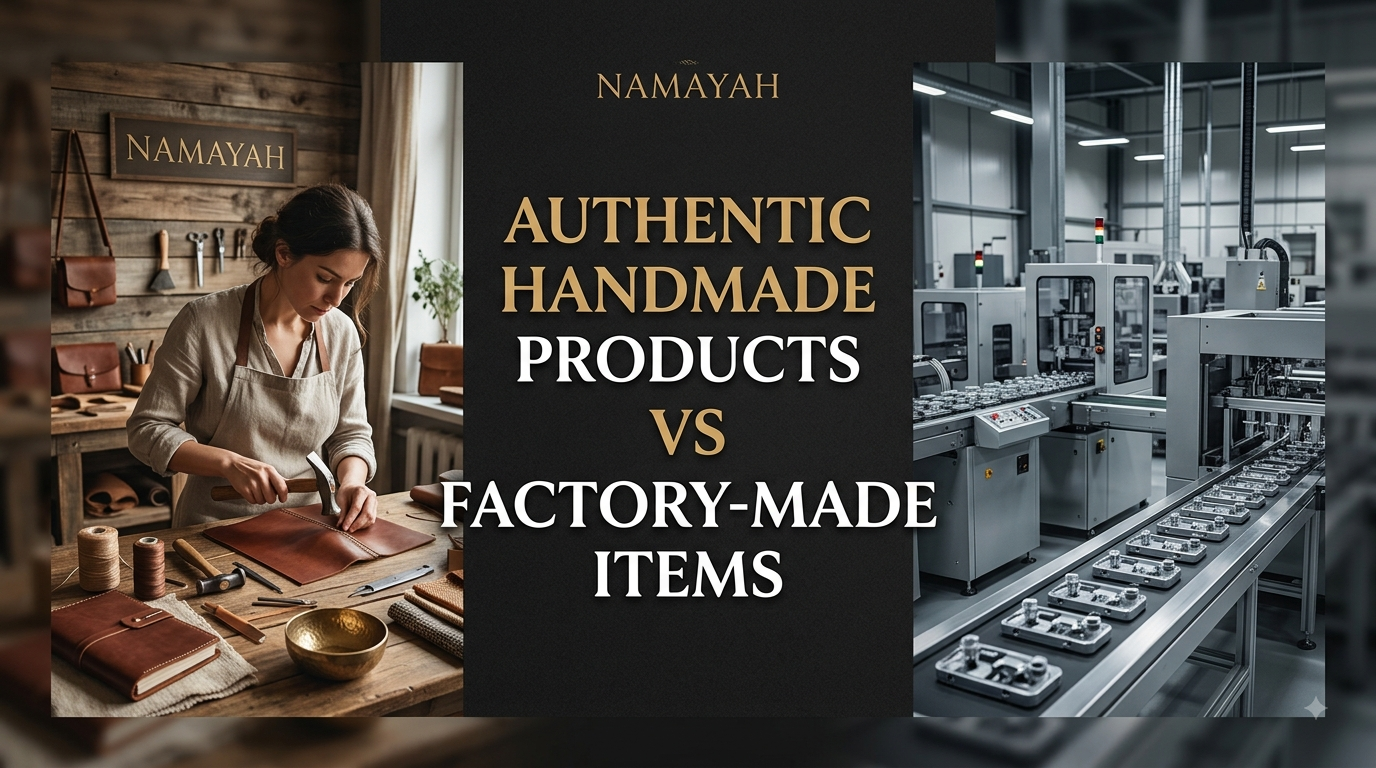
When shopping for furniture, clothing, home décor, gifts, accessories, or everyday goods, you may find yourself choosing between an authentic handmade product and a factory-made alternative. Handmade products can offer individuality, craftsmanship, and a closer connection to the person who made them. Factory-made items, meanwhile, can provide consistency, affordability, availability, and precise manufacturing at scale.
Neither option is automatically better for every situation. The right choice depends on what matters most to you: uniqueness, customization, price, durability, consistency, sustainability, or supporting individual makers.
What Is an Authentic Handmade Product?
An authentic handmade product is made with meaningful involvement from a person or artisan rather than being entirely produced through automated mass manufacturing.
“Handmade” does not necessarily mean that every step is performed without tools or machinery. Skilled makers may use sewing machines, power tools, kilns, molds, or other equipment. The important distinction is the maker’s meaningful involvement, skill, judgment, and craftsmanship.
For example, a handmade wooden table may be cut and sanded using power tools while still being designed, assembled, finished, and inspected by an individual craftsperson.
Some handmade marketplaces use particularly strict definitions. Handmade.com, for example, says a maker’s hands must be meaningfully involved in creating the item and prohibits factory-made products from being presented as handmade.
This distinction matters because the word “handmade” can sometimes be used loosely in marketing. Buyers should look beyond the label and investigate how an item is actually produced.
What Are Factory-Made Items?
Factory-made items are produced in manufacturing facilities using standardized processes, machinery, specialized equipment, and production systems.
Factory production can range from highly automated manufacturing to processes where workers perform individual assembly or finishing tasks. The defining feature is usually production at scale using standardized methods.
This approach makes it possible to produce large quantities of similar products efficiently. It also allows manufacturers to establish repeatable specifications and quality-control procedures.
For products that need to be identical, widely available, or produced in very large quantities, factory manufacturing can be extremely practical.
Handmade vs Factory-Made: Key Differences
| Factor | Handmade Products | Factory-Made Items |
|---|---|---|
| Production | Primarily maker-led | Standardized manufacturing |
| Uniqueness | Often contains individual variations | Usually highly consistent |
| Customization | Often easier for small-batch makers | Usually limited to available options |
| Production speed | Generally slower | Generally faster |
| Availability | May be limited | Usually widely available |
| Price | Often higher because of labor and smaller scale | Often lower because of scale and efficiency |
| Consistency | May vary slightly between pieces | Usually highly consistent |
| Craftsmanship | Strong focus on individual skill | Strong focus on repeatable processes |
| Sustainability | Can be resource-efficient, depending on materials and methods | Efficiency can reduce resource use per unit, but impacts depend on the full supply chain |
| Personal connection | Often stronger | Usually less direct |
The table shows why there is no universal winner. Each production model solves a different problem.
Craftsmanship and Human Skill
One of the biggest attractions of handmade products is the visible role of human skill.
An artisan may select materials, adjust techniques, respond to imperfections, and make decisions throughout production. Small differences in texture, shape, stitching, glazing, carving, or finishing can become part of the item’s character.
This is especially valuable when buyers want something distinctive rather than perfectly uniform.
However, handmade does not automatically mean higher quality. A skilled artisan can produce exceptional work, but handmade goods can also vary in execution. Quality depends on the maker’s experience, materials, process, and quality-control standards.
Factory manufacturing has its own form of expertise. Engineers, technicians, designers, and production specialists can develop sophisticated systems that produce highly consistent results.
Consistency and Precision
Consistency is one area where factory-made products often have a clear advantage.
Once a manufacturing process has been engineered and tested, a factory can reproduce the same dimensions, specifications, colors, and components across a large production run.
This is particularly important for products where precision matters. Standardized manufacturing can also make replacement parts, matching sets, and repeat purchases easier.
Handmade products may have small variations because each piece is individually produced. For some shoppers, those variations are desirable. For others, they may be inconvenient.
The better option therefore depends on whether you value individuality or uniformity.
Uniqueness and Customization
If your priority is individuality, handmade products can be particularly appealing.
An artisan may be able to modify dimensions, colors, materials, patterns, finishes, or other details. Small-batch production can make customization easier because the maker is working directly with the customer or has greater flexibility in the production process.
Factory-made products are generally designed for a larger audience. Manufacturers need standardized specifications to make production efficient.
That does not mean factory products cannot be customized. Many manufacturers offer different sizes, colors, configurations, and personalization options. However, customization is usually limited to choices built into the production system.
Materials and Quality Control
Quality depends more on the specific product and maker than simply on whether something is handmade or factory-made.
A handmade product made from excellent materials can be extremely durable. A poorly made handmade product can still fail prematurely.
Likewise, a factory-made product can be inexpensive and disposable, but a well-engineered factory product can also deliver exceptional consistency and durability.
When evaluating quality, consider:
- What materials were used?
- How was the item constructed?
- Is the design appropriate for its intended use?
- Does the maker or manufacturer explain the production process?
- Are there quality-control standards?
- What warranty or repair options are available?
- Do independent reviews identify recurring problems?
Looking at these factors provides a more reliable assessment than assuming “handmade” automatically means “better.”
Price and Production Time
Handmade products often cost more because an individual artisan or small team may spend substantial time designing, preparing, producing, finishing, and inspecting each item.
A factory can spread equipment, labor, logistics, and other production costs across a large number of units. Once a manufacturing system is established, producing additional units can become more efficient.
This creates a fundamental difference in economics.
When buying handmade, part of the price may reflect the labor and skill required to produce a relatively small number of items. When buying factory-made, the price may benefit from economies of scale.
A higher price therefore does not automatically prove superior quality, just as a lower price does not automatically indicate poor quality.
Sustainability and Waste
The sustainability comparison is more complicated than simply saying handmade is environmentally friendly and factory-made is harmful.
Some handmade production uses local, natural, or renewable materials and relatively modest amounts of energy. India’s Office of the Development Commissioner (Handicrafts), for example, describes handicrafts as potentially supporting sustainability goals through local materials and lower-resource production processes.
But the environmental impact of any product depends on its complete lifecycle.
Consider:
- Material extraction
- Energy used during production
- Water consumption
- Packaging
- Transportation
- Production waste
- Product lifespan
- Repairability
- End-of-life disposal
Factory production can sometimes use highly efficient machinery and standardized processes that minimize material waste per unit. At the same time, producing enormous quantities of short-lived goods can create significant resource and waste challenges.
The best sustainability choice is therefore often a durable, repairable product made with responsible materials and an appropriate production process.
Supporting Artisans and Communities
Buying directly from an artisan can provide income to an individual maker or small business and help maintain traditional skills.
This can be particularly significant for crafts connected to local cultural traditions. In India, concerns about factory-made substitutes replacing traditional crafts have been reported in regional artisan communities, where lower-priced alternatives can make it harder for craftspeople to sustain their trades.
However, buying factory-made products can also support manufacturing workers, designers, engineers, logistics companies, retailers, and other parts of a broader supply chain.
The question is therefore not simply whether one system creates jobs. Both do. The difference lies in the type and structure of economic activity they support.
How to Tell If a Product Is Truly Handmade
The word “handmade” alone should not be the only evidence you consider.
Before purchasing, look for information about the maker and production process.
1. Research the maker
Look for a real maker, workshop, studio, or business with information about who creates the products.
2. Check the production description
A trustworthy seller should be able to explain how the product is made without relying only on vague phrases such as “artisan inspired.”
3. Look for process photographs
Images showing a workshop, tools, materials, or stages of production can provide useful context.
4. Ask specific questions
If you are uncertain, ask who makes the item, where it is produced, what parts are handmade, and whether any production is outsourced.
5. Be cautious about identical mass listings
If the same supposedly handmade product appears across many unrelated shops with identical photographs and descriptions, investigate further.
Community discussions have also highlighted concerns about mass-produced goods being resold as handmade, although visual checks and reverse-image searches are not foolproof.
6. Check the seller’s policies
Some marketplaces publish detailed definitions of what qualifies as handmade. These policies can provide a useful benchmark for evaluating product claims.
When Handmade Products Are the Better Choice
Handmade may be the better choice when you want:
- A distinctive product
- Custom sizing or design
- Traditional craftsmanship
- A direct connection with the maker
- Small-batch production
- A meaningful gift
- A product with visible individual character
- To support independent artisans
Handmade products can be especially appealing for items where personality and craftsmanship are part of the value, such as ceramics, jewelry, textiles, furniture, artwork, and decorative objects.
When Factory-Made Products Make More Sense
Factory-made products may be the better choice when you prioritize:
- Affordable pricing
- Fast availability
- Consistent dimensions
- Large quantities
- Standardized replacement parts
- Repeat purchases
- Technical precision
- Easy access to warranties or established service networks
For everyday products where consistency and affordability matter more than individuality, factory manufacturing can be the practical choice.
How to Choose the Right Product
Instead of asking only, “Is handmade better than factory-made?” ask five more useful questions:
1. What will I use it for?
A decorative object and a technical component may require very different production characteristics.
2. How important is uniqueness?
Choose handmade when individual character is a major part of what you want.
3. How important is consistency?
Factory-made products may be preferable when identical specifications matter.
4. Does the price match the value?
Compare materials, construction, durability, customization, service, and expected lifespan—not just the sticker price.
5. Can I verify the production story?
Look for transparent information about who made the product and how it was produced.
FAQs About Handmade and Factory-Made Products
Are handmade products always better than factory-made products?
No. Handmade products can offer craftsmanship, individuality, and customization, while factory-made products can provide consistency, precision, affordability, and large-scale availability. Quality depends on the specific product, materials, manufacturing process, and quality controls.
Why are handmade products often more expensive?
Handmade products may require substantially more direct labor per item and are often produced in smaller quantities. The price can reflect the maker’s time, skill, materials, customization, and business costs.
How can I know if a product is genuinely handmade?
Research the maker, read the production description, examine workshop or process photographs, ask who produces the item, and check whether the seller or marketplace has a clear definition of handmade.
Are factory-made products lower quality?
Not necessarily. Factory production can provide sophisticated quality-control systems and highly consistent manufacturing. A factory-made product can be excellent quality, while a handmade product can vary depending on the maker and materials.
Are handmade products more sustainable?
Not automatically. Some handmade products use local materials and relatively low-resource production methods, but sustainability depends on materials, energy, transportation, packaging, durability, repairability, and disposal.
Why do people prefer handmade products?
Many buyers value uniqueness, craftsmanship, customization, cultural connection, and the ability to support individual makers. These benefits are especially important when the story and character of a product are part of its value.
Are handmade products more durable?
They can be, but “handmade” alone does not establish durability. Look at construction methods, materials, maker expertise, intended use, maintenance requirements, and evidence of long-term performance.
Can factory-made products be sustainable?
Yes. Efficient manufacturing, responsible materials, reduced waste, durable design, repairability, and optimized logistics can all contribute to a more sustainable product. The overall lifecycle matters more than whether a product is simply handmade or factory-made.
Conclusion
The choice between authentic handmade products and factory-made items is not simply a contest between “better” and “worse.”
Handmade products can offer individuality, craftsmanship, customization, and a direct connection to makers. Factory-made products can deliver consistency, affordability, precision, availability, and scalable production.
The smartest purchase is the one that matches your priorities.
If uniqueness, craftsmanship, customization, and supporting individual artisans matter most, an authentic handmade product may provide greater value. If affordability, consistency, speed, or standardized specifications matter more, a factory-made product may be the better fit.