
The Role of Artisans in Preserving India’s Craft Heritage
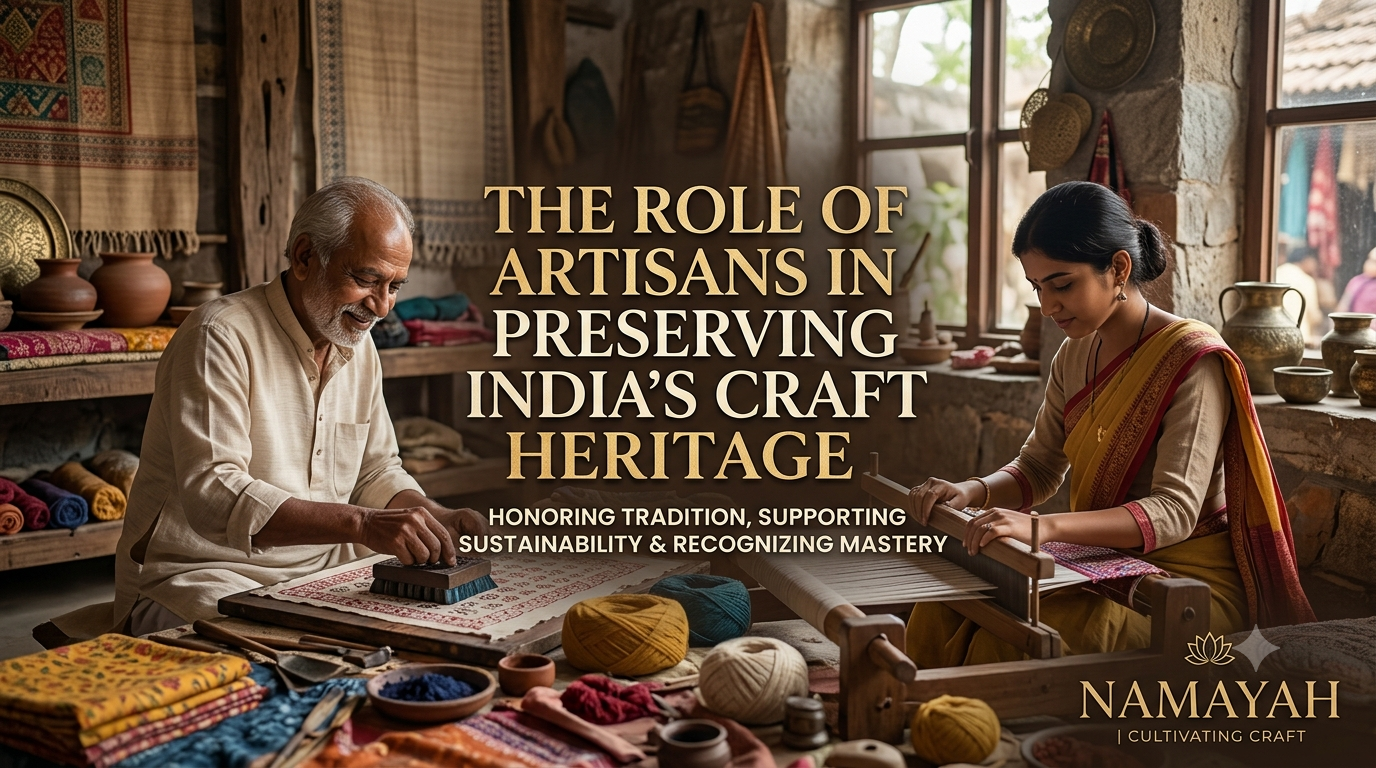
What Is India’s Craft Heritage?
India’s craft heritage is a vast collection of traditional skills, techniques, materials, designs, and cultural practices developed and maintained by communities across generations. It includes weaving, embroidery, pottery, metalwork, wood carving, painting, basketry, jewellery, leatherwork, and many other forms of handmade production.
What makes this heritage especially valuable is that it is not limited to finished objects. The knowledge behind those objects—the choice of materials, preparation methods, tools, patterns, techniques, and cultural meanings—is also part of the heritage.
UNESCO describes traditional craftsmanship as a particularly tangible expression of intangible cultural heritage. Its safeguarding approach emphasizes keeping the associated skills and knowledge alive by supporting artisans and encouraging the transmission of those skills within communities.
This is where Indian artisans play a vital role.
Artisans as Keepers of Traditional Knowledge
An artisan does more than make a product by hand. In many traditional craft communities, the artisan carries knowledge that may have been developed and refined over generations.
A weaving technique, for example, can involve knowledge of yarn, looms, patterns, colour combinations, preparation, and finishing. A metalworker may need to understand how different materials respond to heat, pressure, shaping, and polishing. A potter develops an understanding of clay, moisture, firing, form, and local materials.
Much of this knowledge is learned through practice rather than textbooks.
India’s traditional brass and copper craft of the Thatheras of Jandiala Guru provides a notable example. UNESCO inscribed the craft on its Representative List of the Intangible Cultural Heritage of Humanity in 2014. The organization notes that the craft represents not only a means of subsistence but also a social and cultural identity for the Thathera community.
The artisan therefore becomes a living link between the past and the present.
Passing Skills From One Generation to the Next
One of the most important roles artisans play in preserving India’s craft heritage is teaching.
Traditional craft knowledge has often been transferred through families, workshops, apprenticeships, and community relationships. Young learners observe experienced craftspeople, practice basic techniques, make mistakes, and gradually develop the skill required for independent work.
This process preserves more than a particular design. It can preserve the logic behind a craft.
UNESCO highlights apprenticeship and community-based transmission as important ways of safeguarding traditional craftsmanship. It also warns that some craft knowledge can disappear when younger generations no longer choose to learn it.
For this reason, preserving Indian crafts requires making artisan knowledge valuable for the next generation. If young people can see a sustainable livelihood and meaningful future in traditional craftsmanship, the chances of continued transmission become stronger.
Preserving Regional Identity Through Craft
Indian crafts are closely connected with geography and community identity. Different regions have developed distinctive materials, techniques, motifs, colours, and production traditions.
The same broad category of craft can look very different from one region to another because artisans respond to local environments, histories, communities, and cultural influences.
Textile traditions offer a strong example. UNESCO’s documentation of India’s iconic saree-weaving clusters describes weaving traditions associated with several states and emphasizes the relationship between craftsmanship, production spaces, materials, techniques, and cultural continuity.
When artisans continue these practices, they help preserve regional identities that cannot be fully captured by written descriptions alone.
Traditional Crafts as Living Heritage
It is tempting to think of heritage as something that belongs in museums. Traditional crafts demonstrate why this definition is too narrow.
A craft tradition remains alive when people continue to practice, teach, adapt, and use it.
UNESCO’s approach to traditional craftsmanship focuses on safeguarding the skills and knowledge rather than simply preserving craft objects. The objective is for communities to continue producing crafts and passing their knowledge forward.
This distinction is important. A museum can preserve an old textile, tool, or vessel, but it cannot by itself preserve the complete knowledge required to recreate that object.
The artisan can.
Examples of Indian Craft Traditions
India’s craft heritage includes an enormous range of traditions. Some are associated with particular communities or geographical regions, while others have evolved through centuries of cultural exchange.
Examples include:
- Handloom weaving and traditional textile production
- Embroidery and surface ornamentation
- Pottery and terracotta
- Brass and copper metalwork
- Wood carving
- Traditional painting
- Basketry and bamboo crafts
- Jewellery making
- Leather crafts
- Handcrafted toys and decorative objects
The Thathera craft of Jandiala Guru illustrates how a specific traditional technique can become closely connected to community identity. UNESCO’s listing recognizes the traditional manufacture of brass and copper utensils and the cultural significance of the practice.
These examples also demonstrate that Indian craft heritage is not a single tradition. It is a network of many living traditions.
The Role of Artisans in Cultural Storytelling
Crafts often communicate stories through patterns, colours, symbols, materials, and forms.
A handmade object can reflect a community’s relationship with nature, religion, local history, celebrations, occupations, or social customs. The meaning may be embedded in a motif or technique that an outsider might see simply as decoration.
Artisans preserve this cultural vocabulary by continuing to use and explain it.
India’s broader approach to intangible cultural heritage recognizes traditions as expressions of collective memory, identity, values, and continuity. UNESCO’s reporting on India notes the importance of safeguarding knowledge and skills associated with traditional crafts alongside other cultural practices.
This makes artisans important cultural storytellers. Their work can communicate aspects of Indian heritage in a form that people can see, touch, use, and pass on.
Challenges Facing Indian Artisans
Preserving traditional crafts is not simply a matter of asking artisans to continue making the same products.
Craft communities can face several challenges, including:
- Changing consumer preferences — Mass-produced goods can compete with handmade products on price and availability.
- Limited transmission of skills — Younger community members may pursue other careers if craft work does not provide sustainable opportunities.
- Access to markets — Skilled artisans may have difficulty reaching customers beyond their local areas.
- Raw-material challenges — Traditional crafts can depend on particular natural or locally available materials.
- Loss of traditional knowledge — When experienced artisans retire without apprentices, techniques may disappear.
- Imitation and commercialization — Traditional designs can be reproduced without adequately recognizing the communities that developed them.
UNESCO identifies globalization, changing markets, and declining interest among potential successors as challenges for traditional craftsmanship more broadly. It also points to stronger markets, apprenticeships, financial incentives, and appropriate intellectual-property measures as possible safeguarding approaches.
Modern Markets and Traditional Craft
Preserving craft heritage does not necessarily mean freezing traditions in the past.
Artisans can adapt traditional skills to contemporary needs. A weaving technique may be applied to modern home furnishings. A traditional decorative style may appear in contemporary fashion. Pottery can be designed for modern interiors while retaining handmade production methods.
The important distinction is between adaptation and loss of identity.
Thoughtful innovation can help crafts remain economically viable while maintaining their underlying knowledge and community connections.
UNESCO’s World Crafts Forum, held in New Delhi in November 2024 in collaboration with the Ministry of Textiles and the World Crafts Council, highlighted traditional crafts and artisanship in relation to cultural legacy, economic activity, and sustainable development.
Modern markets can therefore become part of preservation when artisans have meaningful control over how their skills and traditions evolve.
Technology and New Opportunities
Technology can also help traditional artisans reach audiences beyond their immediate communities.
Digital marketplaces, social media, online exhibitions, digital storytelling, photography, and educational content can increase visibility for handmade products and the people who make them.
Technology can also support documentation. Recording techniques, oral histories, patterns, workshop practices, and artisan stories can help create resources for future research and education.
However, documentation should complement living practice rather than replace it. A digital archive cannot substitute for an apprentice learning directly from an experienced craftsperson.
The strongest approach combines documentation with real opportunities for artisans to continue practicing and teaching their craft.
How Consumers Can Support Craft Heritage
Consumers also have a role in preserving India’s craft heritage.
Buying directly from artisans or reputable craft organizations can help create demand for handmade products. Learning about the origin of a product can help consumers distinguish authentic craft from generic mass-produced imitations.
Consumers can also:
- Ask who made the product and where it was produced.
- Learn about the technique behind a craft.
- Value craftsmanship rather than judging handmade goods only by price.
- Share artisan stories responsibly.
- Choose durable handmade products when appropriate.
- Support organizations involved in craft preservation and education.
- Encourage younger generations to view craftsmanship as a skilled profession.
The goal is not simply to purchase more products. It is to create an environment in which traditional skills continue to have cultural and economic value.
Why Preserving Artisanship Matters
India’s craft heritage represents more than beautiful objects. It contains accumulated knowledge about materials, techniques, design, community identity, and cultural expression.
When an artisan teaches a younger person how to weave, carve, shape metal, paint, stitch, or work with clay, a piece of cultural knowledge moves into the future.
That is why artisans should be viewed as partners in heritage preservation rather than merely as producers of traditional goods.
India’s experience with intangible cultural heritage demonstrates the connection between communities, cultural continuity, and safeguarding. UNESCO currently lists 16 elements associated with India’s intangible cultural heritage, including the traditional brass and copper craft of the Thatheras of Jandiala Guru.
The continued presence of artisans is essential because heritage survives most effectively when it remains part of everyday life.
Frequently Asked Questions
1. What is the role of artisans in preserving Indian culture?
Artisans preserve Indian culture by maintaining traditional skills, techniques, designs, materials, and knowledge and passing them to future generations. Their work keeps cultural practices active rather than allowing them to become only historical records.
2. Why are traditional Indian crafts important?
Traditional Indian crafts are important because they reflect regional identity, community knowledge, artistic traditions, and cultural history. They also provide livelihoods and maintain specialized skills that may otherwise disappear.
3. How do artisans pass craft skills to younger generations?
Artisans commonly pass skills through observation, practice, family teaching, workshops, apprenticeships, and community-based learning. This allows practical knowledge to develop through direct experience.
4. What challenges do Indian artisans face?
Indian artisans can face competition from mass-produced goods, changing consumer preferences, limited market access, difficulties obtaining materials, inadequate income opportunities, and declining interest among younger generations.
5. Can modern technology help preserve Indian crafts?
Yes. Digital marketplaces, social media, online education, documentation, and digital storytelling can increase visibility and connect artisans with new audiences. Technology works best when it supports living craft communities rather than replacing traditional knowledge transmission.
6. How can consumers help Indian artisans?
Consumers can support artisans by purchasing responsibly made handmade products, learning about their origins, valuing craftsmanship, sharing authentic artisan stories, and choosing products that provide meaningful economic opportunities for craft communities.
7. What is an example of an Indian craft recognized by UNESCO?
The traditional brass and copper craft of utensil making among the Thatheras of Jandiala Guru in Punjab was inscribed on UNESCO’s Representative List of the Intangible Cultural Heritage of Humanity in 2014.
8. Is preserving craft heritage the same as preserving old objects?
No. Preserving craft heritage involves maintaining the skills, knowledge, practices, and community transmission that allow crafts to continue. UNESCO specifically emphasizes safeguarding craftsmanship knowledge and skills, not only finished objects.
Conclusion
The role of artisans in preserving India’s craft heritage is fundamental. They carry practical knowledge from one generation to another, maintain regional traditions, express cultural stories, and adapt established techniques to changing circumstances.
The future of Indian craft heritage depends on keeping these traditions living, useful, respected, and economically sustainable.
Preservation therefore cannot stop at museums, archives, or exhibitions. It must include the people who possess the knowledge and the communities in which that knowledge has meaning.
When artisans have opportunities to practice their skills, teach apprentices, reach customers, and innovate without losing the essence of their traditions, India’s remarkable craft heritage has a stronger path into the future.