
The History of Copperware in Indian Households
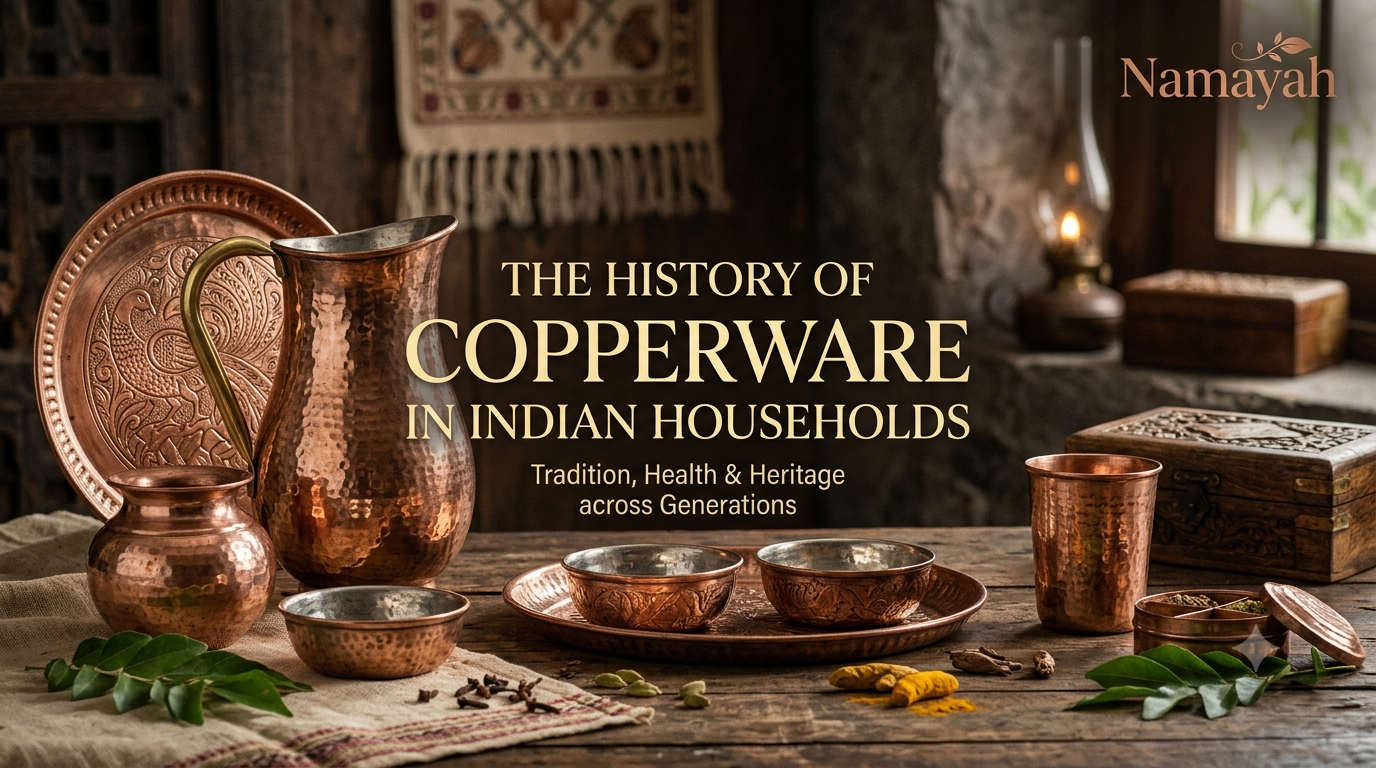
Copperware has occupied a distinctive place in Indian households for centuries. Copper vessels have been used for storing and serving water, preparing and presenting food, religious ceremonies, and decorative purposes. Archaeological evidence shows that copper vessels existed in ancient Indian societies, while later traditions connected copper with domestic routines, Ayurveda, and ritual practices.
The history of copperware in Indian households is therefore more than the story of a metal. It reflects India’s long traditions of metallurgy, craftsmanship, cooking, religion, water storage, and domestic life.
Copper in Ancient India
Copper is among the earliest metals worked by human societies in the Indian subcontinent. Archaeological research on the Indus Valley Civilization demonstrates that copper was used for tools, ornaments, weapons, and vessels. A study published by the Indian National Science Academy notes that Harappan communities had mastered copper and used it for several classes of objects, including vessels.
This does not mean that copper replaced pottery in everyday life. Pottery remained extremely important for cooking and storage, particularly because it was practical and widely available. Evidence from South Indian Chalcolithic sites, for example, shows that pottery was a major industry serving everyday cooking and storage needs.
Copper vessels were consequently part of a broader material culture rather than the only type of household container.
Copperware and the Indus Valley Civilization
One of the earliest archaeological connections between copper and vessels in South Asia comes from the Indus Valley Civilization.
Excavations at Harappa have documented copper vessels. The Harappa archaeological collection records a copper pot recovered during the 1924–25 excavations, demonstrating that copper vessels formed part of the material record of the civilization.
Research into the Harinagar Hoard has also examined copper vessels associated with the Harappan cultural tradition. The study describes the Harappan civilization as a highly organized Chalcolithic culture in which copper was used for vessels as well as tools and other objects.
These discoveries provide an important historical foundation for understanding India’s later familiarity with copper objects.
From Metalworking to Household Vessels
The development of copperware was closely connected to advances in metalworking. Copper could be hammered, shaped, heated, polished, decorated, and combined with other metals.
Over time, Indian metalworkers developed specialized skills for producing household and ceremonial objects. The broader history of Indian metallurgy includes evidence for copper production, metalworking, and the use of copper and copper alloys in different regions.
This craftsmanship eventually produced many familiar forms: pots, plates, cups, bowls, water vessels, lamps, containers, and ritual objects.
The resulting vessels were not simply functional. Their shape, finish, engraving, weight, and decoration could also communicate regional identity, craftsmanship, and social or religious significance.
Copperware in Traditional Indian Kitchens
In traditional Indian homes, utensils were made from a variety of materials, including clay, iron, brass, bronze, copper, and later stainless steel.
Copper had particular advantages as a workable metal. Artisans could create relatively thin sheets and shape them into vessels through hammering and other metalworking techniques.
Copperware could be used for storing or serving water and, depending on the vessel and its treatment, for particular cooking or serving purposes. However, copper is reactive with acidic foods, which is one reason traditional copper and brass vessels were often given a protective tin coating known as kalhai. The Indian National Trust for Art and Cultural Heritage notes that tin coating reduced the chemical action caused when sour or acidic foods came into contact with copper and brass.
This traditional practice illustrates how Indian households adapted metalware to practical cooking requirements.
The Lota, Kalash, and Other Copper Vessels
Some copper vessels became especially recognizable within Indian domestic and cultural life.
The lota, a rounded vessel generally associated with carrying or storing water, is one of the best-known traditional Indian vessel forms. Historical collections contain copper lotas used in both domestic and ritual contexts. Research on the former India Museum collection describes several copper lotas and notes that the boundaries between household and ritual use could be fluid.
The kalash is another important vessel associated with Indian ritual traditions. While kalash vessels can be made from different materials, copper versions are widely associated with ceremonial settings.
Other copper objects included plates, bowls, water containers, lamps, and specialized ritual vessels.
Together, these objects show how the same material could move between practical household life and religious practice.
Copperware and Ayurveda
Copper also acquired an important place in traditional Indian health and dietary practices.
Ayurvedic literature discusses the use of different materials for vessels and water storage. Modern research has examined some of these traditional practices rather than treating historical claims as automatically equivalent to modern medical evidence.
One laboratory study examined water stored in copper pots and found that several tested diarrhoeagenic bacteria were no longer recoverable after 16 hours of storage under the study conditions.
Another study examined water stored for 24 hours in vessels made from copper, silver, clay, plastic, and steel, measuring total dissolved solids rather than establishing broad health benefits.
These findings are interesting, but they should not be interpreted as proof that drinking copper-stored water provides every health benefit sometimes claimed online. Traditional practice, laboratory evidence, and modern medical recommendations are different categories of evidence.
Copper in Indian Religious and Ritual Life
Copper has long had significance beyond ordinary household use.
Copper vessels have been used in religious ceremonies, particularly for holding or offering water and other ritual substances. Historical museum collections contain copper vessels explicitly identified with ritual use alongside objects that served domestic purposes.
This overlap is significant. In many Indian traditions, an object did not necessarily have to be exclusively “religious” or “domestic.” A vessel could be useful in daily life and also become part of a ceremonial setting.
Copper’s durability, distinctive reddish-golden appearance, and established place in Indian metalworking contributed to its continuing cultural visibility.
The Tradition of Kalhai
One of the most interesting parts of India’s copperware history is kalhai, the traditional process of coating copper or brass vessels with tin.
Copper can react with acidic ingredients. Tin coating created a protective inner surface, allowing certain vessels to be used more appropriately for cooking and storing foods.
Historically, kalhaiwallas specialized in this work. INTACH’s account of the tradition describes artisans who operated from workshops or moved from house to house to tin-coat household vessels.
The practice demonstrates an important feature of traditional Indian household technology: utensils were maintained rather than simply discarded when they became worn.
A vessel could be cleaned, repaired, polished, and re-tinned, extending its useful life.
Regional Copperware Traditions
Indian copperware is not a single uniform tradition. Different regions developed distinctive techniques, shapes, decorations, and artisan communities.
Kashmir is particularly notable for its copperware tradition. India’s official handicrafts portal describes Kashmiri copperware as a craft with a history extending over several centuries, involving processes such as cutting, heating, hammering, engraving, and polishing. It also identifies specialized artisan roles involved in decorative work.
Elsewhere in India, copper and copper-alloy vessels developed their own local forms and decorative traditions.
Regional variation is one reason copperware should be understood as part of India’s wider craft heritage rather than merely as a category of kitchen utensils.
Kashmiri Copperware
Kashmiri copperware demonstrates how utility and artistry could exist in the same object.
Traditional artisans shape copper sheets through processes that can involve heating and hammering before adding decorative details. Engraving and related techniques can transform an otherwise functional vessel into a highly decorated household or ceremonial object.
Historically, such craftsmanship required specialized knowledge passed between generations.
Today, mechanization and changing consumer preferences create challenges for traditional metalworking communities. The survival of copperware therefore depends not only on consumer demand but also on preserving the skills and knowledge behind its production.
Why Copperware Declined in Modern Kitchens
Copper did not disappear from India, but its everyday role changed significantly during modernization.
Stainless steel became increasingly attractive for household kitchens because it is durable, relatively easy to clean, resistant to many forms of corrosion, and suitable for mass production.
Aluminium, enamelware, plastics, non-stick cookware, and other modern materials also expanded household choices.
As a result, copper vessels that once served practical household functions increasingly became associated with:
- Ritual practices
- Decorative displays
- Traditional kitchens
- Heritage collections
- Specialized cookware
- Water storage
- Gifts and ceremonial occasions
The change illustrates how household technology evolves. Traditional utensils may decline in daily use while gaining new cultural or decorative value.
Copperware in Contemporary Indian Homes
Copperware has experienced renewed interest in modern Indian homes.
Some households use copper bottles, glasses, jugs, and serving vessels as a way of reconnecting with traditional practices. Others purchase copperware because of its appearance, craftsmanship, durability, or cultural associations.
At the same time, responsible use matters. Copper vessels should be appropriate for their intended purpose and properly maintained. Acidic foods should not be stored in unlined copper vessels because copper can react with acidic ingredients; traditional tin coating is one historical solution to this issue.
The modern revival of copperware is therefore best understood as a combination of heritage, design, craftsmanship, and selected traditional practices—not simply as a return to an earlier kitchen.
What Copperware Represents in Indian Culture
The history of copperware in Indian households reveals several overlapping stories.
First, it represents technological knowledge. Ancient communities developed ways of extracting, shaping, and working copper.
Second, it represents domestic culture. Copper vessels became part of household routines involving water, food, cooking, and serving.
Third, it represents craftsmanship. Techniques such as hammering, engraving, polishing, and tin coating required specialized knowledge.
Fourth, it represents ritual continuity. Copper vessels have been used in religious and ceremonial contexts alongside everyday household objects.
Finally, copperware represents adaptation. As stainless steel and other modern materials changed Indian kitchens, copperware shifted from being an everyday necessity in some households to becoming a marker of tradition, craftsmanship, and heritage.
FAQs About the History of Copperware in Indian Households
When did copperware first appear in India?
Copper objects are documented in archaeological contexts associated with ancient South Asian cultures, including the Indus Valley Civilization. Archaeological evidence includes copper vessels as well as tools and other objects.
Why was copper used for vessels in India?
Copper was a workable and durable metal that could be shaped into vessels. It also became embedded in Indian culinary, domestic, and ritual traditions over many centuries.
Was copper used in the Indus Valley Civilization?
Yes. Archaeological discoveries from Harappa and research on Harappan copper collections provide evidence for copper vessels and other copper objects.
What is kalhai?
Kalhai is the traditional tin-coating of copper or brass vessels. The coating helped reduce chemical interaction between the metal and acidic foods. Specialized artisans known as kalhaiwallas historically performed this work.
Why are copper vessels used in Indian rituals?
Copper vessels have been used for holding and offering water and other substances in religious ceremonies. Historical collections show that copper objects could have both domestic and ritual functions.
Why did stainless steel replace copper in many Indian kitchens?
Stainless steel offered practical advantages for modern mass-produced kitchens, including durability, ease of maintenance, and suitability for everyday cooking and storage. Its widespread adoption reduced the need for traditional metal vessels in many households.
Is drinking water from a copper vessel scientifically supported?
Some laboratory studies have found antibacterial effects when contaminated water was stored in copper vessels under specific experimental conditions. However, such findings should not be generalized into claims that copper-stored water provides all the health benefits sometimes attributed to it.
What is Kashmiri copperware?
Kashmiri copperware is a regional metalworking tradition involving shaped copper vessels and decorative techniques such as engraving. India’s handicrafts portal identifies it as a centuries-old craft tradition.
Conclusion
The history of copperware in Indian households stretches from ancient metalworking traditions to the kitchens, temples, workshops, and homes of modern India. Archaeological evidence establishes copper’s presence in early South Asian cultures, while later traditions gave copperware practical, artistic, domestic, and ritual significance.
From the humble lota to elaborately decorated Kashmiri vessels, copperware demonstrates how an everyday material can become part of cultural memory. Although stainless steel and other modern materials have transformed Indian kitchens, copper continues to survive as a symbol of craftsmanship and heritage.
Its story is ultimately not about replacing modern utensils with traditional ones. It is about understanding how Indian households have used materials, skills, and objects to connect everyday life with history.