
The Craftsmanship Behind Indian Brass Utensils
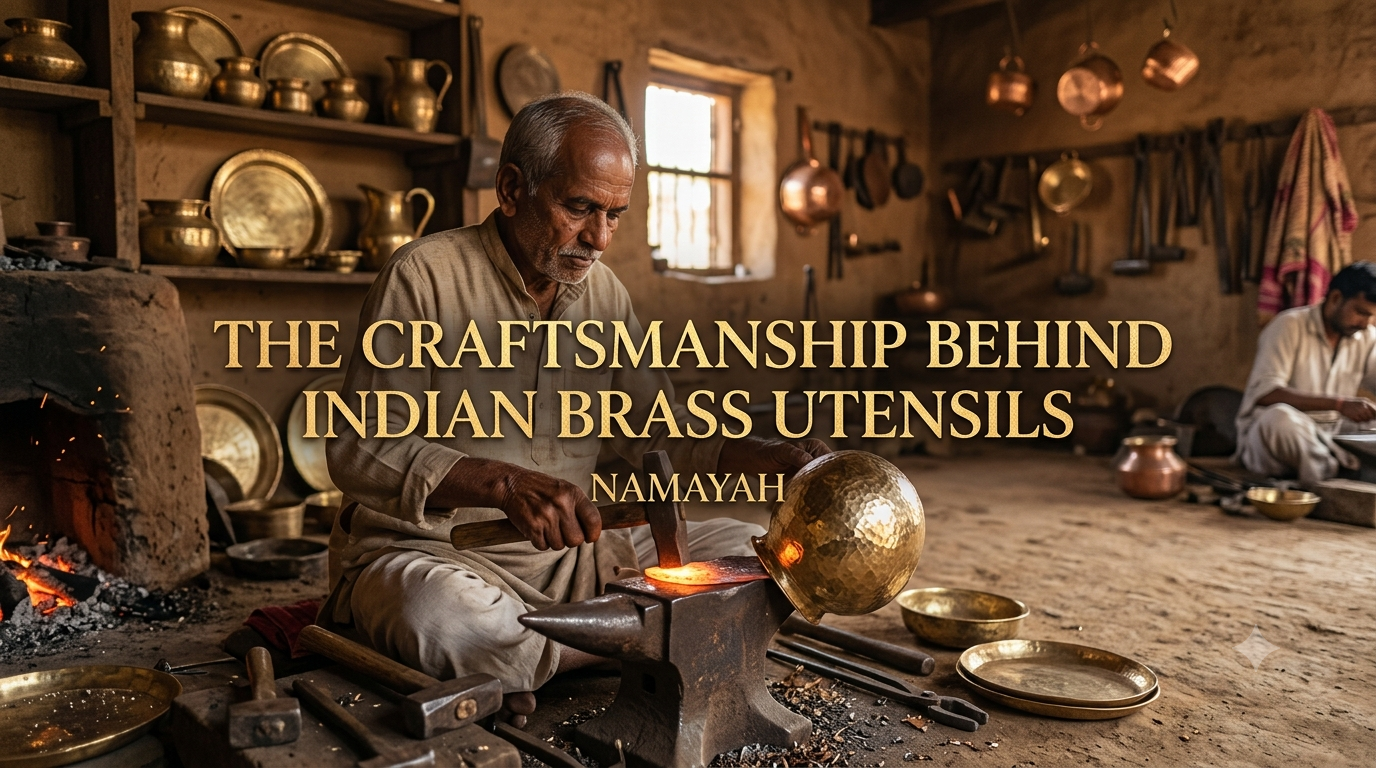
Indian brass utensils are more than functional kitchenware. They represent a long tradition of metalworking in which material knowledge, hand skills, design, and cultural practices come together. From shaping and hammering brass to polishing its surface and adding decorative details, traditional brassware reflects the patience and precision of skilled artisans.
Today, handcrafted brass utensils continue to attract attention because they connect everyday objects with India’s rich craft heritage. Their appeal comes not only from their warm golden appearance but also from the visible traces of human workmanship that can distinguish one piece from another.
What Makes Indian Brass Utensils Unique?
Indian brass utensils are distinctive because they combine function, durability, craftsmanship, and cultural meaning.
Brass is an alloy primarily made from copper and zinc. Its workability makes it suitable for forming a wide variety of objects, while its characteristic golden-yellow appearance gives finished utensils a recognizable visual identity.
Traditional Indian brassware can include plates, bowls, cups, serving vessels, storage containers, lamps, and ceremonial objects. Designs and production methods vary considerably by region and artisan tradition.
A handmade utensil may contain subtle variations in shape, hammer marks, surface texture, or decorative work. Rather than automatically indicating poor quality, these variations can be evidence of manual production.
A Brief History of Brass in India
Metalworking has deep roots in the Indian subcontinent, with archaeological evidence showing sophisticated knowledge of copper and other metals in ancient societies. Over centuries, Indian craftspeople developed diverse traditions involving copper alloys, including brass.
Brass became particularly important for household objects, religious articles, decorative pieces, and ceremonial vessels. Different communities and regions developed their own approaches to casting, forming, engraving, polishing, and ornamentation.
The history of Indian brassware is therefore not a single story. It is a collection of regional craft traditions shaped by available materials, local markets, cultural practices, and generations of artisan knowledge.
How Brass Utensils Are Traditionally Made
The production of a brass utensil can involve several stages. The exact process depends on the type of product, the region, the workshop, and whether the object is cast, hammered, spun, or produced using another metalworking method.
Selecting and Preparing the Metal
The process begins with brass in an appropriate form for the intended manufacturing technique.
Artisans need to consider factors such as thickness, workability, dimensions, and the desired finish. In workshops using traditional methods, preparing the material correctly is important because later shaping depends on its condition.
For some forms of brassware, the metal may be heated during working. Controlled heating can make the material easier to shape and helps artisans perform demanding forming operations.
Shaping the Utensil
Shaping is one of the most important stages.
Depending on the craft tradition, an artisan may use tools and techniques designed for casting, hammering, pressing, or spinning. A vessel that appears simple to the consumer can require considerable control to achieve a balanced shape and consistent thickness.
The artisan gradually transforms the metal into the intended form while checking its proportions.
This is where experience becomes particularly important. Skilled craftspeople can recognize how the metal is responding to pressure, heat, and repeated working.
Hammering and Hand-Finishing
Hammering can serve both functional and decorative purposes.
Repeated blows can help shape and strengthen certain forms while also creating a distinctive surface texture. In some traditions, the hammer marks become part of the visual character of the finished object.
Hand-finishing may involve filing, smoothing, trimming, or refining edges. These steps require attention because utensils must be comfortable to handle as well as visually appealing.
Polishing and Final Detailing
The final appearance of brassware depends heavily on finishing.
Artisans may smooth the surface and polish it to achieve anything from a bright golden appearance to a more subdued traditional finish. Decorative work, engraving, or other details may also be added depending on the product.
A well-finished utensil demonstrates the connection between technical metalworking and aesthetic judgment.
The Artisans Behind the Craft
The most important part of traditional brassware is arguably the knowledge held by the artisan.
Metalworking requires more than following a fixed sequence of steps. Craftspeople develop an understanding of tools, heat, pressure, metal behavior, proportions, and finishing through practice.
In traditional craft communities, knowledge can also pass from one generation to another. Apprentices may learn by observing experienced workers and gradually taking responsibility for increasingly complex tasks.
This makes handmade brassware a form of living cultural knowledge, rather than simply an old manufacturing technique.
Traditional Designs and Motifs
Indian brassware can range from minimalist household vessels to highly decorated ceremonial objects.
Depending on the region and purpose, artisans may incorporate:
- Floral patterns
- Geometric borders
- Engraved lines
- Traditional symbols
- Textured surfaces
- Decorative handles
- Embossed details
The design is often closely connected to the object’s intended use. A simple serving vessel may prioritize functionality, while a ceremonial object can place greater emphasis on ornamentation.
This diversity is one reason Indian brassware cannot be reduced to a single visual style.
Cultural and Ritual Importance
Brass has an important place in many Indian cultural and religious contexts.
Brass objects are commonly associated with traditional पूजा (puja) settings and ceremonial practices, where metal lamps, vessels, and other objects can have symbolic and practical roles. Brass lamps, for example, are widely recognized elements of Indian devotional traditions.
The material’s enduring presence in rituals has helped connect brass craftsmanship with family traditions and cultural memory.
For many households, a traditional brass object can therefore represent more than its practical function. It may be associated with festivals, ceremonies, family gatherings, or inherited customs.
Brass Utensils in Modern Indian Homes
Traditional brassware is not limited to museums or ceremonial spaces.
Modern households may use brass objects as serving pieces, decorative accents, dining accessories, or special-occasion utensils. Some consumers are also drawn to brass because handcrafted objects provide a visual contrast to mass-produced stainless steel, glass, and plastic products.
The modern appeal of brass lies partly in this combination of heritage and contemporary design.
A traditional brass bowl can work in a classic interior, while a simpler handcrafted vessel can fit naturally into a modern kitchen or dining setting.
Handcrafted vs. Mass-Produced Brassware
Not every brass utensil is made using the same process.
| Feature | Handcrafted Brassware | Mass-Produced Brassware |
| Production | Often involves substantial manual work | Usually relies more heavily on standardized machinery |
| Appearance | May show subtle individual variations | Usually highly uniform |
| Design | Can reflect regional craft traditions | Often designed for scalable production |
| Artisan involvement | High in many traditional workshops | Varies by manufacturing process |
| Character | Each piece can have a distinctive finish | Consistency is usually prioritized |
| Craft value | Strong connection to traditional skills | Focus tends to be on efficiency and repeatability |
This does not mean that one category is automatically better for every buyer. Mass production can provide consistency and accessibility, while handcrafted products can offer distinctive character and support traditional craft practices.
How to Care for Brass Utensils
Proper care can help maintain the appearance of brass utensils.
Clean Regularly
Use a soft cloth or sponge and a mild cleaning approach appropriate for brass. Avoid unnecessarily aggressive scrubbing that can scratch the surface.
Dry Thoroughly
After washing, dry the utensil completely. This helps prevent water spots and keeps the surface looking cleaner.
Consider the Finish
Some brass products have specialized finishes or coatings. Follow the manufacturer’s care instructions rather than assuming that every brass object should be polished in the same way.
Avoid Harsh Abrasives
Strong abrasive materials can alter the surface and remove decorative or aged finishes.
Check Whether the Utensil Is Food-Safe
If a brass object is intended for serving or cooking, confirm that its construction and finish are suitable for food contact. Some decorative brass products are intended only for display.
Choosing Authentic Brass Utensils
When buying traditional Indian brass utensils, look beyond appearance.
Consider the following:
- Ask about the material. Confirm whether the product is solid brass, brass-plated, or made from another metal.
- Learn about the production method. Sellers should be able to explain whether the item is handmade, cast, spun, hammered, or machine-produced.
- Inspect the finish. Look for clean edges, consistent construction, and a finish appropriate to the product.
- Consider the intended use. Decorative pieces and food-contact utensils may have different requirements.
- Ask about care. A reputable seller should provide practical cleaning and maintenance guidance.
- Learn about the artisan or workshop. When available, information about the craft tradition can add useful context and help buyers make more informed decisions.
Why Traditional Brass Craftsmanship Still Matters
Traditional brass craftsmanship matters because craft knowledge can disappear when fewer people have opportunities to practice and pass it on.
Supporting responsible artisan businesses and craft communities can help maintain demand for skilled work. It can also encourage younger generations to see traditional metalworking as a viable craft rather than merely a historical practice.
For consumers, buying handcrafted brassware can create a closer relationship with the object itself. Instead of viewing a utensil as an anonymous manufactured product, the buyer can appreciate the materials, techniques, design decisions, and human labor behind it.
The future of Indian brassware will likely involve both tradition and adaptation. Artisans can preserve established techniques while developing designs that suit contemporary homes and changing consumer preferences.
FAQs About Indian Brass Utensils
Are Indian brass utensils handmade?
Many traditional Indian brass utensils are handmade or involve significant manual craftsmanship, although manufacturing methods vary. Buyers should check the specific product and seller for accurate information about how an item was produced.
Why are brass utensils traditionally used in India?
Brass has long been valued for its workable properties, distinctive appearance, durability, and cultural associations. It is used for household, decorative, ceremonial, and religious objects across different Indian traditions.
What is Indian brass made of?
Brass is primarily an alloy of copper and zinc. The exact composition can vary depending on the intended properties and manufacturing requirements.
Are brass utensils safe for cooking?
Safety depends on the utensil’s composition, construction, finish, and intended use. Consumers should follow the manufacturer’s instructions and use only products specifically designed and approved for food preparation or serving.
How do you keep brass utensils shiny?
Regular gentle cleaning and thorough drying can help maintain brassware. If polishing is appropriate for the specific finish, use a brass-safe method and follow the manufacturer’s recommendations.
How can you tell if brassware is handmade?
Handmade pieces may display subtle variations in shape, texture, hammer marks, or finishing. However, appearance alone cannot conclusively establish how an item was manufactured, so seller or artisan information is more reliable.
Why is handmade Indian brassware valuable?
Its value can come from the combination of material, artisan skill, design, cultural significance, labor, and uniqueness. The relative importance of each factor varies by product and buyer.
Can brass utensils be used for everyday dining?
Some brass utensils are designed for everyday dining, while others are decorative or ceremonial. Always confirm that the specific product is intended for food contact and follow its care instructions.
Conclusion
The craftsmanship behind Indian brass utensils is a story of material, skill, tradition, and adaptation. From preparing and shaping brass to hammering, polishing, and detailing the finished object, every stage can reflect knowledge developed through years of practice.
What makes traditional Indian brassware particularly meaningful is the connection between utility and culture. A simple vessel can carry traces of regional design, artisan knowledge, family tradition, and India’s long history of metalworking.
As contemporary consumers rediscover handcrafted products, Indian brass utensils continue to demonstrate how traditional craftsmanship can remain relevant in modern life.