
How Indian Heritage Inspires Modern Design
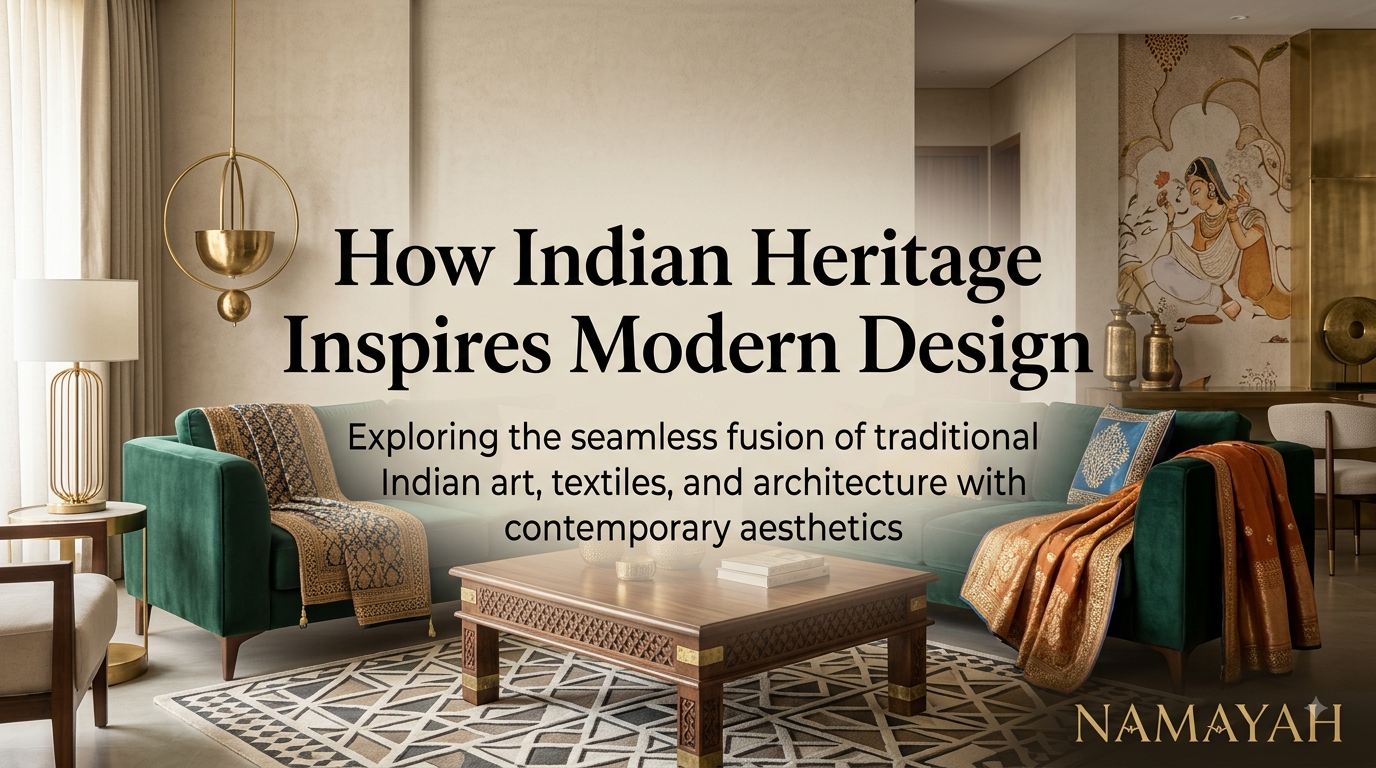
Indian heritage offers modern design something more valuable than decoration: a deep vocabulary of materials, patterns, craftsmanship, spatial ideas, and cultural stories. From traditional jali screens and courtyards to handwoven textiles, block printing, carved wood, metalwork, and regional motifs, Indian design traditions continue to influence contemporary architecture, interiors, fashion, and products.
The strongest modern interpretations do not simply copy historic objects. They study the principles behind them and adapt those principles to contemporary needs. Traditional Indian crafts, for example, are increasingly being reinterpreted through new silhouettes, materials, and applications rather than treated as museum pieces. UNESCO describes India’s textile crafts as living traditions that are renewed as each generation reinterprets their techniques and design vocabulary.
This relationship between heritage and innovation helps explain why Indian-inspired modern design can feel both familiar and fresh.
Why Indian Heritage Matters to Modern Design
India’s design heritage is exceptionally diverse because different regions have developed distinct approaches to architecture, textiles, craft, materials, ornamentation, and everyday objects.
For contemporary designers, this diversity creates an extensive source of inspiration. A designer might study the geometry of Mughal architecture, the woven structures of regional textiles, the organic forms of traditional crafts, or the restrained material palette of a vernacular building.
The important point is that heritage does not have to mean recreating the past.
Instead, designers can ask:
- What problem did the traditional design solve?
- Why was a particular material chosen?
- How did climate influence the architecture?
- What does a particular motif communicate?
- How was an object made?
- How can the underlying idea work in a contemporary setting?
This approach turns heritage into a design resource rather than a decorative theme.
India’s continuing investment in craft-and-design education also reflects this idea. In 2026, the Indian government announced the establishment of SANCHAY, a craft-based resource centre at IIT Roorkee intended to connect craft heritage with design, technology, education, and community empowerment.
Indian Architecture as a Source of Modern Inspiration
Indian architecture provides some of the clearest examples of heritage influencing modern design.
Historic buildings across the subcontinent demonstrate sophisticated responses to climate, light, privacy, movement, materials, and social life. Contemporary architects can reinterpret these ideas without reproducing an old architectural style.
Jali, Courtyards, and Climate-Responsive Design
The traditional jali, or perforated screen, is one example.
Historically, patterned screens were used in parts of Indian architecture to filter sunlight, encourage air movement, and create varying degrees of privacy. Contemporary architects can reinterpret the idea using stone, brick, concrete, metal, wood, or digitally fabricated screens.
The principle is more important than the exact pattern: create a building envelope that controls light, air, and visual connection.
Recent architectural commentary has highlighted how traditional Indian techniques such as jali screens, stone masonry, and terracotta are being reconsidered for contemporary climate-responsive architecture.
Courtyards provide another valuable lesson. Rather than treating a building as a sealed box, traditional courtyard planning can create an internal relationship between architecture, daylight, airflow, plants, and social activity.
Modern designers can reinterpret the courtyard in apartments, offices, hotels, schools, and private homes.
This demonstrates an important principle: heritage can influence modern design through function as well as appearance.
Traditional Indian Crafts in Contemporary Design
Indian craftsmanship is another major source of modern design inspiration.
Craft traditions encompass weaving, embroidery, printing, carving, pottery, metalwork, painting, basketry, stonework, and many other practices. These techniques often contain regional knowledge accumulated over generations.
Contemporary design can bring those techniques into new contexts.
For example, a traditional textile pattern might appear on a modern chair, a historic embroidery technique might be applied to a contemporary garment, or a handcrafted metal process might be used for lighting or furniture.
The goal is not necessarily to preserve every craft in exactly the same form. UNESCO’s work on Indian textile heritage emphasizes that living craft traditions remain viable partly because they are renewed and adapted across generations.
Textiles, Weaving, and Embroidery
Indian textiles have an especially strong relationship with modern design.
Regional traditions such as Banarasi weaving, Ajrakh printing, block printing, embroidery, and handloom weaving offer designers distinctive textures, construction methods, and visual languages.
Contemporary fashion demonstrates how these traditions can be transformed rather than simply reproduced. For example, recent Indian fashion collections have used craft techniques in contemporary silhouettes and materials, showing how traditional processes can remain relevant to modern wardrobes.
This approach can also apply to interiors.
A handwoven textile can become upholstery, a traditional print can be adapted for cushions or curtains, and embroidery can become an art installation rather than remaining limited to clothing.
The result is often more nuanced than simply adding a traditional pattern to a modern product.
Wood, Metal, Clay, and Stone
Materials themselves can carry cultural identity.
Hand-carved wood, brass and other metalwork, terracotta, stone carving, natural fibres, and handmade ceramics all provide tactile qualities that mass-produced surfaces may not reproduce easily.
Modern designers can use these materials selectively. A contemporary interior, for example, might combine clean architectural lines with one carved wooden screen or a handcrafted metal light.
This creates contrast: modern geometry provides simplicity, while traditional workmanship adds texture and character.
The Influence of Indian Colors and Patterns
Indian visual culture is often associated with strong colors, intricate motifs, and layered decoration. However, modern designers do not have to reproduce that visual richness literally.
A contemporary interpretation might isolate one element of a traditional palette or pattern.
For example:
- A detailed floral motif can become a simplified geometric pattern.
- A traditional textile palette can inspire a restrained interior color scheme.
- A carved architectural detail can become a repeating graphic.
- A traditional border can be transformed into a modern furniture detail.
- A historic geometric pattern can inspire contemporary product surfaces.
This process of abstraction is important.
Instead of placing many heritage elements together, designers can identify one recognizable characteristic and give it room to work within a modern composition.
From Traditional Motifs to Modern Minimalism
Indian heritage and minimalism are not opposites.
In fact, traditional design can provide useful inspiration for minimalist spaces when designers focus on materiality, proportion, texture, and craftsmanship.
A contemporary room might have neutral walls, simple furniture, and uncluttered surfaces while incorporating a single handwoven rug, carved screen, brass object, or textile artwork.
The heritage element becomes an accent rather than the entire visual language.
This approach also prevents cultural references from becoming overly literal.
Modern Indian design can therefore move beyond the idea that an Indian-inspired space must contain ornate furniture, bright colors, or highly decorative patterns. Heritage can be expressed through subtle details, natural materials, spatial planning, craftsmanship, and locally meaningful forms.
Indian Heritage and Sustainable Design
Traditional practices can also offer lessons for sustainability, although designers should avoid assuming that every traditional method is automatically sustainable.
Many craft traditions emphasize repair, reuse, local materials, manual skills, and long-term making practices. Their contemporary relevance depends on how responsibly they are practiced and adapted.
The connection between heritage, craft, and sustainability has received institutional attention as well. UNESCO has discussed Indian crafts in the context of safeguarding intangible cultural heritage and sustainable development.
For modern designers, the lesson is broader than simply choosing a handmade material.
It can involve asking:
- Where did the material come from?
- Who made the product?
- What skills are required?
- Can the product be repaired?
- Can the material be reused?
- Is the design appropriate for its intended environment?
- Are artisans and communities fairly involved?
These questions can turn heritage-inspired design into a more thoughtful process.
Regional Diversity Creates a Rich Design Vocabulary
There is no single Indian design style.
A design inspired by Rajasthan may look very different from one influenced by Kerala, Kashmir, Gujarat, Bengal, Tamil Nadu, or the Northeast.
This regional diversity is one of India’s greatest design strengths.
Different environments have influenced different materials and techniques. Local traditions have also developed distinct visual languages, construction methods, textiles, decorative arts, and everyday objects.
For designers, this means research matters.
Instead of using a vague idea of “Indian style,” a project can identify a specific region, craft, architectural tradition, material, or historical influence.
That makes the design more meaningful and gives audiences a clearer understanding of where its inspiration comes from.
Fashion and Product Design: Tradition in New Forms
The influence of Indian heritage extends well beyond buildings and interiors.
Fashion designers regularly reinterpret traditional textiles, embroidery, weaving, printing, and surface decoration. Product designers can similarly draw from traditional objects, materials, motifs, and manufacturing techniques.
The transformation can happen at several levels.
Material: A traditional textile may be used in a contemporary garment or product.
Technique: An old craft process can be applied to a new form.
Pattern: A historical motif can be simplified for modern branding or product surfaces.
Structure: A traditional object can inspire a contemporary functional product.
Story: A product can communicate the history of a craft without directly copying its traditional form.
Recent Indian fashion coverage illustrates this broader movement, describing craft as an evolving design language rather than a static historical category.
How Designers Can Use Indian Heritage Responsibly
Using cultural heritage successfully requires more than finding an attractive motif.
Designers should research the origin and meaning of the elements they use. They should understand whether a technique is associated with a particular community, region, ceremony, or historical context.
A responsible design process can include five steps.
1. Research the Source
Identify the craft, region, material, technique, or architectural tradition behind the inspiration.
2. Understand the Meaning
Find out whether the motif or object has cultural, religious, ceremonial, or social significance.
3. Work With Knowledge Holders
Where possible, collaborate with artisans, craftspeople, historians, designers, or communities connected to the tradition.
4. Adapt Rather Than Copy
Modern design should solve a contemporary problem. Use the heritage reference as a starting point rather than reproducing historical objects without context.
5. Credit the Inspiration
Clear attribution can help audiences understand the cultural origin of the design and recognize the knowledge behind it.
This approach can make heritage-inspired design more authentic while reducing the risk of treating culture as a superficial visual trend.
The Future of Indian-Inspired Modern Design
The future of Indian-inspired design is unlikely to be about choosing between tradition and modernity.
Instead, the strongest work will probably continue to combine both.
Technology can help designers document craft processes, experiment with forms, and develop new applications. At the same time, traditional knowledge can provide ideas that technology alone cannot easily generate: tactile experience, regional identity, material intelligence, and cultural meaning.
The growing connection between craft, design, and technology is already visible in institutional initiatives such as SANCHAY at IIT Roorkee, which aims to integrate craft heritage with technology and design education.
For modern designers, Indian heritage is therefore not simply a library of historical images. It is a living source of ideas.
Its greatest value may lie in the questions it encourages designers to ask about materials, climate, identity, craftsmanship, community, and function.
FAQs About Indian Heritage and Modern Design
How does Indian heritage influence modern design?
Indian heritage influences modern design through architecture, textiles, craftsmanship, materials, patterns, colors, spatial planning, and regional traditions. Designers often reinterpret these elements for contemporary products, buildings, interiors, and fashion rather than copying historical designs.
What are examples of Indian heritage used in modern architecture?
Examples include reinterpretations of jali screens, courtyards, traditional shading strategies, stonework, terracotta, and locally appropriate materials. These ideas can contribute both cultural identity and functional performance to contemporary buildings.
Why are Indian textiles important to modern design?
Indian textiles contain distinctive weaving, printing, embroidery, dyeing, and pattern-making traditions. Contemporary designers can adapt these techniques to modern clothing, interiors, accessories, and products while maintaining connections to regional craftsmanship.
Can Indian heritage work with minimalist interiors?
Yes. Heritage can be incorporated through a small number of carefully selected elements, such as handcrafted textiles, carved wood, metalwork, ceramics, or architectural screens. Minimalism can provide space for individual craft pieces to become visual focal points.
How does traditional Indian craft support contemporary design?
Traditional craft provides designers with materials, techniques, textures, patterns, and knowledge that can be adapted to contemporary applications. The process can also help keep living craft traditions relevant when adaptation is done thoughtfully and with appropriate community involvement.
Is Indian-inspired design always colorful and decorative?
No. Indian design heritage includes both highly ornamental traditions and approaches based on simplicity, natural materials, geometry, proportion, texture, and climate-responsive planning. Contemporary designers can draw from either or combine them.
How can designers avoid cultural appropriation when using Indian heritage?
Designers should research the source of their inspiration, understand its cultural context, collaborate with relevant artisans or knowledge holders where appropriate, avoid misrepresenting sacred or culturally specific symbols, and give clear credit to the tradition or community involved.
What is the future of Indian heritage in modern design?
Indian heritage is likely to remain a source of contemporary innovation as designers combine traditional craftsmanship and knowledge with new materials, technologies, manufacturing methods, and global design practices. The emphasis is increasingly on evolution rather than simple preservation.
Conclusion
Indian heritage inspires modern design by providing more than visual motifs. It offers ideas about materials, craftsmanship, climate, geometry, color, space, identity, and making.
The most effective contemporary interpretations do not attempt to recreate the past exactly. They identify what made a traditional practice valuable and translate that principle into a modern context.
A jali can inspire a contemporary façade. A handwoven textile can become modern furniture. A traditional craft technique can find a new product application. A regional material can shape a contemporary interior.
In this way, heritage remains alive through use and reinterpretation.
Indian design’s future is not about choosing tradition over innovation. It is about discovering how the knowledge of the past can help create thoughtful, distinctive, and relevant designs for the future.